

STYLE IN ACTION
July 20, 2012
JEAN VARON: AVENGERS DESIGNER
It's been a while since we looked at this wonderful time capsule from British Pathe. Made in 1965, the camera crews captured a Jean Varon fashion show that highlighted his designs for Mrs. Peel on The Avengers. Although the narrator mis-identifies the first model as Diana Rigg, the outfits are the real McCoy. Spy Vibers will recognize most of the collection from Rigg's first season in 1965-1966. Patrick Macnee also makes an appearance in the audience, with his trademark charm and twinkle in the eye. Jean Varon was actually the house-name of fashion designer, John Bates (born 1938), through the 1960s. He was well-known for creating modernistic outfits that were championed by British Vogue, the Fashion Museum in Bath, and by Diana Rigg in The Avengers. Bates (Varon) was an early adopter of Op Art elements in his black and white mini-coats and accessories. Some claim that Bates, not Courreges nor Quant, created the mini skirt. Ahead of his time, he was also making plastic garments as early as 1962.
I've been re-watching the 1965-1966 season of The Avengers and there are some wonderful moments when the camera just pans down to advertise Mrs. Peel's latest look. One memorable outfit, seen in this newsreel, is a silver vinyl ensemble with bra bodice, low-rise pants, and jacket. Bates was a great advocate of bra-lessness and of showing the midriff (and as much as possible!). The Telegraph caught up with him for a 2006 interview in Wales, where the designer-turned painter lives with his partner. If you want to learn more about Varon/Bates, check out John Bates: Fashion Designer by Richard Lester (not to be confused with the 1960's film director). Enjoy!


July 19, 2012
BARBICAN EXHIBIT TOUR
The New York Times talked yesterday with Ab Rogers, designer of the Designing 007: 50 Years of Bond Style exhibit at Barbican. In the interview Rogers takes us on a tour through the show, including a recreation of Ian Fleming's office at Goldeneye in Jamaica, where visitors hear the sound of a typewriter and birds chirping. Great to learn that the exhibit did not leave Bond's creator out of the picture. Asked which of the film's evil lairs were his favorite, Rogers said, "I think Goldfinger’s ranch is pretty extraordinary: the floor plane sliding away, tables rotating to reveal maps, very satisfying. But I also loved the conceit of Blofeld’s empire hidden in a volcano in “You Only Live Twice.” The carving-out of the interior, the grafting of sharp steel architectural details, louvered walls, even a monorail network, into the rock was beautifully simple and marvelously conceived in Adam’s original concept sketches. More recently in “GoldenEye,” I thought the idea of villain Alec Trevelyan operating from a customized decommissioned military locomotive was an interesting take on modern mobile solutions. If I had to choose one lair, it would be “The Man With the Golden Gun.” I like the way it opens up out of the rock with incredible clarity. The combination of shining materials, technology and concrete against the natural elements of rock, vegetation and the power of the sun is fantastic." The exhibit will be in London through September 5th, before moving to Toronto. Read more at The New York Times.

Scroll down for recent editions of our series, For Your Shelf Only, where guests share stories about collecting and show us some of their treasures. Series links: Jon Gilbert, Raymond Benson, Jeremy Duns, Peter Lorenz, David Foster, Rob Mallows, Roger Langley. You can find James Bond books and other spy treasures in Spy Vibe's secure Amazon Store.

Scroll down for recent editions of our series, For Your Shelf Only, where guests share stories about collecting and show us some of their treasures. Series links: Jon Gilbert, Raymond Benson, Jeremy Duns, Peter Lorenz, David Foster, Rob Mallows, Roger Langley. You can find James Bond books and other spy treasures in Spy Vibe's secure Amazon Store.
July 18, 2012
007 VEHICLE PREVIEW
Secret agent 007 has always taken his fans on thrilling rides as he pursues baddies around the globe. From the famous car scene in Fleming's Moonraker novel, to the Aston Martin models in the films, the Bond vehicles have become an extension of the character's uniform. Fans have enjoyed seeing original props from the films at the Bond in Motion exhibit, at the Designing Bond show at Barbican, and recently at ComiCon. Motortrend announced today that the upcoming James Bond film, Skyfall, will feature a chase scene atop Honda CRF250R motorcycles. Twenty Honda motorcycles were provided for the film, including two CRF450R bikes used to capture all the action with HD cameras. More info at Motortrend. You can also get a close-up tour with Cinema Retro.


July 16, 2012
FOR YOUR SHELF ONLY: CRAIG ARTHUR
For Your Shelf Only continues! Spy Vibe recently talked with Jon Gilbert, rare book dealer and author of Ian Fleming: The Bibliography. Our chat began a new series on Spy Vibe, offering fellow collectors and fans of spy novels a chance to share their experiences and some of their prized books.
Our next guest is Craig Arthur. Craig has been working on his first spy novel for
several years. He studied English at the University of Otago. His
articles researching and analyzing James Bond-related topics have appeared on commanderbond.net and mi6-hq.com. He has also written for spywise.net.
How did you first get
exposed to the world of James Bond?
I was already aware of Ian Fleming via Chitty Chitty Bang Bang
– a favourite story of mine from as far back as I could remember, although I
didn’t actually own a copy and I never saw the 1968 movie because I was too
young. For a while, Chitty remained my only link to Fleming.

Then I saw [the
movie] The Spy Who Loved Me at age 9 in 1977. The only way to see Bond
movies in those days was in the cinema. I was lucky I became a Bond fan
when I did, because it meant I saw all of the Bond movies on the big-screen
while they were still in circulation. At the time, however, I did not
know when, if ever, I would get to see the earlier films, and it was a long
two-year wait between the new movies. There were no
VCRs. Nor were Bond movies shown on New Zealand television the way
they were in the UK and America. I would see copies of Christopher
Wood’s James Bond: The Spy Who Loved Me whenever I was in a
bookshop but I did not have the means to buy it. The Fleming Bond novels,
like the early Connery Bond films, were something beyond my reach.
When did you start to
read Ian Fleming?
I was highly aware of my geographic isolation. London
was the centre of the Bondian universe and, as Wikipedia points out, my
hometown of Dunedin, New Zealand, is the most distant city on Earth from
London. Even when a new movie was released, I would have to wait an extra
six months for it to reach our shores. Then, after its initial release,
there was no telling when I might get to see it again. So, I would latch
onto whatever talismans of Bond-related material I could. Bond books, the
original Fleming novels or anything else related to Bond or spies, provided the
most accessible, concrete touchstones. Assuming I could obtain
them.
In 1978, when I was
staying with my grandparents, my grandmother was reading a Jonathan Cape Fleming
omnibus on loan from the St Kilda Public Library, containing Dr No, Live and Let Die, and Diamonds
Are Forever. I read the opening chapter of Dr No, somewhat perturbed by the detailed descriptions of zinging
and tinkling crickets and frogs, ex-patriot English cocktail hour rituals in
Jamaica, and night-scented jasmine. For a 10 year old, there seemed a lot
of detail to wade through before we meet the ‘three blind men’ and an even
longer wait before anything actually ‘happens’. But it did not dampen my
curiosity and I was able to memorise the titles of all the Fleming novels from
the list inside the book.
In 1979, I saw both
Thunderball and Goldfinger on the big screen and was counting down the months to
the December release of Moonraker. That same year one or two of the new 1978 Grafton paperback editions of the
Fleming novels appeared in local bookshops. I saved up my pocket money
and purchased On Her Majesty’s Secret Service while on holiday in Wanaka. It proved a difficult read for me as an 11 year old. I enjoyed the
opening sequence but got bogged down in Fleming’s lengthy digressions on the
subject heraldry. I did not read any further until I began intermediate
school in 1980 where I found the Patrick Nobes abridged version in the school
library. I then read Patrick Nobes’s abridged Bull’s-Eye editions of Goldfinger
and Live
and Let Die. I also discovered The Adventures of James Bond
Junior 003 ½ by R.D. Mascott. After moving onto high school, I
lost all access to a copy this book, and then spent the next 25 years looking
for one.

When did you begin to
collect books?
It was while I was still at intermediate school I began
collecting Fleming more seriously. Having exhausted the Bull’s-Eye young
readers’ editions available in the school library, I began buying second-hand
Pan paperbacks of the unabridged Fleming novels from cheap second hand
shops. That same year Licence Renewed was published. I remember staring at the Chopping-style dust-jacket in awe but to purchase a new hardback
book was financially impossible at age 12 or 13.


I continued to go
to see the movies whenever they were shown, and I could convince my parents to
take me, until video killed off demand and they were withdrawn from cinema
circulation. For several years, my parents refused to buy a VCR and so
once again, I only had the literary Bond and new release Bond movies once every
two years to fall back upon.
But paradoxically,
the reason I now have Ian Fleming first editions is because an annual 24 hour
book sale was started up in 1980 to save an opulent 1920s 'super cinema' from
demolition and keep it running as a venue for live performance as well as film. So indirectly, because people stopped going to see movies in the
cinema in the same numbers I would not have been able to built up the book
collection I have today.
Tell us about it.
The community raised funds for the theater through the annual
24-hour sale of donated books each May. Reputedly the largest such event
in the Southern hemisphere. Fortuitously for me, the annual book sale
began at the same time when I started collecting Bond books. I found my
first Ian Fleming first edition at the Regent when I was 14- a 1964 Jonathan
Cape first printing of You Only Live Twice complete with
Richard Chopping dust-jacket – still a cornerstone of my collection
today. It cost me 50 cents (the equivalent of 25 cents US at the time). Between 1982 and 1991 at the Regent, I found For
Your Eyes Only (sans dust-jacket), Thunderball, OHMSS, You
Only Live Twice, The Man With the Golden Gun, a
reprint of The Spy Who Loved Me, along with Kingsley Amis’s The
James Bond Dossier and Colonel Sun. They each cost me
50 cents. I remember being marked-down on the bibliography for my 1991
post-graduate English Literature dissertation on the suspense thriller because
I claimed to have consulted a first edition copy of Thunderball (the examiner refused to accept my copy was a first edition!)

You found some great
treasures. Did it require a lot of patience and hunting?
Often it was not as simple as finding one perfect
copy. I found a copy of OHMSS, sans dust-jacket one year,
for instance, and then a couple of years later an ex-library copy from which I
culled the dust-jacket. I would also find numerous Book Club editions
(far more ubiquitous in these parts than the Jonathan Cape originals). For a while, they filled the gaps in my collection of Fleming hardbacks until I
could find Cape editions.
In 1992, I moved to
Wellington and missed the book sale for the next four years. I only found
three Fleming first editions the entire time I was in Wellington – Octopussy,
The
Living Daylights, and Thrilling Cities. They each
cost me $35. Then in December 1995, I travelled up to Auckland for the
New Zealand premiere of GoldenEye. While I was there, I went around various second hand bookshops asking if they
had any Ian Fleming. For the sum total of $200 NZD, I managed to buy mint
condition 1960s Jonathan Cape reprint editions of Casino Royale, Live
and Let Die, Moonraker, Diamonds Are Forever, Dr No and Goldfinger. It
meant I now had a near complete set of Jonathan Cape hardbacks – everything
apart from From Russia With Love.
At the end of 1996,
I returned to Dunedin and resumed going to the Regent book sale every
May. I didn’t see Ian Fleming books with the same incidence as I did
during the 1980s. But I did eventually find a mint-condition 1965 edition
of From
Russia With Love in 1998, completing my set at long last, shortly
before my 30th birthday. In general, I try to limit my Fleming collection
to one set of Jonathan Cape hardbacks and one set of 1960s Pan paperbacks with
the Raymond Hawkey cover designs. (I’m a big fan of Hawkey’s cover
designs for Len Deighton’s books as well).
Do you collect other authors?
Another important aspect of the Regent book sale for me is
that it gave me access to vintage thriller-writers. Because
I liked Fleming’s novels and indeed the John Gardner Bond continuation novels,
I would seek out the authors who influenced them. Gardner would often
reference older thriller-writers such as Dornford Yates and Ambler in his books
and so I would keep a lookout for authors he alluded to. Also, I had read
O.F. Snelling’s James Bond: A Report, in which Snelling discusses the influence of
what Richard Usborne termed ‘Clubland Heroes’ on Fleming. So, I read
Sapper’s Bulldog Drummond, Dornford Yates, and John Buchan’s Richard Hannay, and
I would keep an eye out for anything by these authors. I looked for
Geoffrey Household, Leslie Charteris’s Saint books (I bought my first Saint
book when I was 10 or 11 years old.), and Somerset Maugham (I found a nice 1928
second impression of Ashenden, sans dust-jacket, one year).

More
recently, I found a 1916 fifth impression of Buchan’s The Thirty-Nine Steps. I
would similarly pounce on any authors who came immediately in the wake of
Fleming as part of the 1960s’ spy craze. I gave all the authors a try:
Adam Hall, Peter O’Donnell, James Mayo, James Leasor, amongst others. I
still collect Adam Hall’s Quiller novels and Peter O’Donnell’s Modesty Blaise.

Something that
hunting through the mass of books at the Regent taught me – you see how Fleming
was head and shoulders above all the dross that was around at the time.
As with musical eras, we tend to look back and see the past as golden. John le Carre, Len Deighton, Ian Fleming and Eric Ambler create a sense of how fantastic
the Cold War era was for the thriller genre. But the dominant popular
fiction at the time was not wonderful. The Regent Theatre book sale was a
graveyard for unwanted fiction. A time capsule of what the majority of
people were reading in the mid-years of the twentieth century. In the
blurb for the 1956 Reprint Society edition of Live And Let Die, Fleming
complained, “the craft of writing sophisticated thrillers is almost
dead.” Again, in 1961, in the blurb of the original Jonathan Cape edition
of Thunderball,
he complains, “In fiction, people used to have blood in their veins. Nowadays they have pond water. My books are just out of step. But
so are all the people who read them.”
When you’re wading
through all the rubbish at the Regent, the endless volumes of Reader’s Digest
condensed books, the forgotten titles by forgotten authors and Alastair Maclean
thrillers, you realise how out of step Fleming was. Even when Raymond
Benson was writing the Bond continuation novels, he coped with a lot of unfair
flack that his books were ‘pornographic’ and I can remember complaints about
the violence in John Gardner’s Bond novels in the 1980s. But great authors like
Fleming, le Carre and Deighton, have proved the test of time.

Can you still find rare
spy thrillers at the Regent?
A big problem with all the dross at the Regent sale is that,
understandably, nobody wants to buy it. And because so much mid-twentieth
century popular fiction has gone unsold over the years, the organisers of the
Regent book sale seemed to have arrived at the conclusion that ‘old’ books do
not sell. As a result, all the hardback fiction prior to circa 1980 is
mysteriously absent from the sale tables. As a friend of mine says, if
books don’t have shiny 1980s’ covers, then they don’t bother putting it on
sale, fearing nobody will buy it. It is not simply a matter of people no
longer donating older books. A friend of mine has found early Fleming
editions at smaller book fairs in the region.
What are you looking
for now?
Charles Cumming and Olen Steinhauer both write spy thrillers
that are equal to anything by their predecessors. I try to obtain their
books in hardback first edition (I’m slowly building up a complete set of
signed US first editions of all Charles Cumming’s books; I was a consultant on The
Trinity Six and Charlie paid me in signed first editions.) I
would still like to find a Jonathan Cape hardback copy of Christopher Wood’s James
Bond: The Spy Who Loved Me, with its incredible Bill Botten
artwork.
I have continued to
collect the James Bond continuation novels, though I much prefer John Gardner
and Raymond Benson to Sebastian Faulks and Jeffrey Deaver. It was not so easy to collect all the Gardner and Benson
Bond novels when they were published. They became increasingly harder to
obtain in this part of the world. Raymond and I have become good friends,
however, and over the years he has sent me signed copies of The
Union Trilogy, A Hard Day’s Death and a
pre-publication copy of The Black Stiletto. I also
bought Charlie Higson’s Young Bond adventures as they came out. I finally
managed to get hold of a nice first edition of The Adventures of James Bond
Junior 003 ½ by R.D. Mascott after a 25-year search. And I was
pleased to get hold of the Puffin facsimile edition of Chitty Chitty Bang Bang
when it was published for the Fleming centenary in 2008.
Is there a book in
your collection that you prize the most?
There's no one book in my collection I prize above the
others. I'm very grateful for all the books I have found over the years. Charles Cumming's The Trinity Six has perhaps the most
personal significance because of the influence I had on some of the material. For instance, I chose the New Zealand setting of Drybread as an homage to
my friend and mentor Owen Marshall – New Zealand's greatest living writer, whose
work is largely unknown beyond these shores.

What do you love about
reading Ian Fleming?
Ian Fleming’s work continues to be important to me. Reading him as an adult, I see him very differently now compared to the way I
saw him as a teenager. In my teens, I was caught up in the fantasy Fleming
created. Bond, the character, was what interested me – the situations he
found himself in. I was disappointed if the stories did not involve Bond
sufficiently, in the same way that I was disappointed when Sherlock Holmes
disappeared from the action in A Study in Scarlet. The
Spy Who Loved Me or short stories such as ‘Quantum of Solace’ or
‘Octopussy’ disappointed me as a teenager for this reason. In my
twenties, my enjoyment of Ian Fleming became more holistic. I enjoyed his
detailed digressions and Fleming became as interesting as Bond himself. There is a sense in reading Fleming that one is dining with a great chef. I marveled at his ability to ‘domestic the marvellous’ (as Kingsley Amis
praised him for), and simultaneously his ability to make mundane everyday
consumer goods or arcane research on heraldry astonishing. If he had
written non-Bond novels, I would have found them equally absorbing. ‘Quantum of Solace’ and ‘Octopussy’ became as gripping as Live and Let Die; the
bridge game in Moonraker as exciting as underwater action or car chases.
Fleming is a
fabulist, often reveling in the grotesque for the simple reason that it
produces what he refers to in From Russia With Love as ‘les
sensations forte’. Strong sensations. He is not asking us to
identify with an apparently sympathetic character like Kerim Bey, who chains
one of his mistresses to a table, holding her captive until she became
submissive. Rather, Fleming is manipulating the reader’s sense of what
creates a disturbingly powerful character in the same way Marquez does in
‘Innocent Erendira and Her Heartless Grandmother’. To quote Borges, “we
do not feel horror because we are threatened by a sphinx; we dream of a sphinx
in order to explain the horror we feel.” Fleming dreamt up many sphinxes,
not only his villains, but characters such Kerim... even Bond himself. To
achieve the same impact his descriptions might have had back in the 1950s
nowadays, writers have to work harder to create a more direct prose. Fleming’s work casts a long shadow over the genre. However, he was
writing in an era when people were more accustomed to florid, baroque grandeur;
they even went to the cinema in picture palaces that resembled the Palais
Garnier, as opposed to the era of the shoebox designs of modern multiplex
cinemas. We live in a very different world today.

Thank you to Craig Arthur for joining us and sharing his experiences hunting for Ian Fleming's books and other spy thrillers. Like many of us who collect, the thrill of the hunt is, and remains by evidence of his stories, the exciting part of bulding up a collection. Scroll down for past editions of our series, For Your Shelf Only, where guests share stories about collecting and show us some of their treasures. Series links: Jon Gilbert, Raymond Benson, Jeremy Duns, Peter Lorenz, David Foster, Rob Mallows, Roger Langley, Craig Arthur, Fleming Short, Matt Sherman. You can find James Bond books and other spy treasures in Spy Vibe's secure Amazon Store.
July 13, 2012
JOHN BARRY RELEASE
Screen Archives Entertainment have released John Barry's score for the 1966 spy thriller, The Quiller Memorandum. From their website: "Cool, classic John Barry soundtrack for superb Michael Anderson 1966 spy thriller starring George Segal, Alec Guinness, Max Von Sydow, Senta Berger. Music first appears on LP from Columbia label in 1966. Inspired by fresh script from Harold Pinter, drawn from Adam Hall best seller, Barry avoids James Bond style of spy music, nods instead towards atmospheric West Germany locale, bleak theme of rising neo-Nazi movement. For the record, composer produces perfect album offering majority of his score in vivid stereo sound. Haunting main waltz-theme "Wednesday's Child" anchors, suspenseful cues play in contrast. Album also features Matt Monro in vocal version of theme. Intrada CD features album program in stereo from Columbia master tapes, courtesy Sony. For album fans, original artwork features on one side of booklet, all new artwork features on other side. Take your pick! John Barry conducts. Intrada Special Collection release available while quantities and interest remain! - Douglass Fake." Below is the trailer for the film, starring George Segal, Alec Guiness (Our Man in Havana), Sente Berger (Man From U.N.C.L.E., The Ambushers), and Ingmar Bergman regular, Max von Sydow (The Kremlin Letter, Three Days of the Condor, Brass Target, Never Say Never Again).

Scroll down for recent editions of our series, For Your Shelf Only, where guests share stories about collecting and show us some of their treasures. Series links: Jon Gilbert, Raymond Benson, Jeremy Duns, Peter Lorenz, David Foster, Rob Mallows, Roger Langley, rare Ian Fleming short. You can find James Bond books and other spy treasures in Spy Vibe's secure Amazon Store.
July 12, 2012
FOR YOUR SHELF ONLY: RARE FLEMING SHORT
For Your Shelf Only continues! Spy Vibe recently talked with Jon Gilbert, rare book dealer and author of Ian Fleming: The Bibliography. Our chat began a new series on Spy Vibe, offering fellow collectors and fans of spy novels a chance to share their experiences and some of their prized books. I'd like to share a brief discovery that I recently made collecting an Ian Fleming short story that is special to me.
Every fan of Ian Fleming has their favorite stories, those well-worn books that we go back to again and again. I like to re-explore the series every few years, a habit I can trace back to age twelve. And although I cherish a few of the novels specifically, the story I always come back to is From a View to a Kill. In this short, James Bond investigates the murder of a dispatch rider in France and discovers an enemy base hidden under ground. According to Chancellor's James Bond: The Man and His World, Fleming originally wrote the premise as a back-story for the Drax character in Moonraker and entitled it "The Rough With the Smooth." There is speculation that his brother Peter's auxiliary soldiers, who dug hidden tunnels to mount attacks in case of enemy invasion during WWII, was an inspiration. Fleming updated the tale to the Cold War era and it was published in For Your Eyes Only in 1962. Like other short stories he wrote, From a View To a Kill appeared in a number of magazines, including Argosy in 1961 (as "Paris Courier"), and Fury Magazine in 1962 (as "A Nice View For Killing"). I recently tracked down a lesser-known appearance in the American men's magazine, Swank, from 1964. I was excited to add this edition to my collection, and to help it onto the radar for Ian Fleming: The Bibliography.
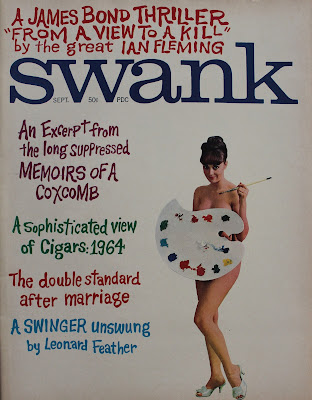
From a View To a Kill is a beautifully contained Bond story. The story opens with an assassination on motorcycles, the scene of which has often provided the illustration concept for the various publications (Swank title illustration below). Fleming's gift with words: "The eyes behind the wide black rubber goggles were cold as flint. In the howling speed-turmoil of a BSA M20 doing seventy, they were the only quiet things in the hurtling flesh and metal. Protected by the glass of the goggles, they stared fixedly ahead from just above the centre of the handlebars, and their dark unwavering focus was that of gun muzzles." Simon Vance does a brilliant reading of this in the Blackstone Audio edition.

Another highlight scene, which provided the title art in Argosy, inspired a spot illustration in the Swank edition. Bond's intuition tells him that the answers lie in a clearing near the Carrefour Royal. He recalls M's dictum to pay attention to "The invisible factor. The invisible man." Gypsies had built an encampment in the clearing, but had left unnoticed some time before the murder. No one saw them leave. In this scene, 007 is dressed head to toe in camouflage (see illustration below). Peering out through tiny slits in his hood, he lays along the branch of a tree over the clearing for hours. The birds give the first warning. James Bond studies the area for some sign of movement. Then, over by the wild roses, he notices a single stem rising up into the air: "Now, silently, the petals of the rose seemed to swivel and expand, the yellow pistils drew aside and sun glinted on a glass lens the size of a shilling." I find the telling of this suspenseful moment endlessly gripping.

From a View To a Kill was published recently in Quantum Of Solace, a compilation of the complete James Bond short stories (2008/limited-edition hard-cover and paperback editions by Penguin). It was also printed in 1999 as part of the Travelman Short Stories series, which I recently added to my collection. This edition is quite unique, as it literally folds out like a large travel map! (cover image below). I look forward to the new Fleming Bibliography and to learning about other editions of Fleming's stories and articles.

See the Cinema Retro page for this post. Scroll down for past editions of our series, For Your Shelf Only, where guests share stories about collecting and show us some of their treasures. Series links: Jon Gilbert, Raymond Benson, Jeremy Duns, Peter Lorenz, David Foster, Rob Mallows, Roger Langley, Craig Arthur, Fleming Short, Matt Sherman. You can find James Bond books and other spy treasures in Spy Vibe's secure Amazon Store.
Every fan of Ian Fleming has their favorite stories, those well-worn books that we go back to again and again. I like to re-explore the series every few years, a habit I can trace back to age twelve. And although I cherish a few of the novels specifically, the story I always come back to is From a View to a Kill. In this short, James Bond investigates the murder of a dispatch rider in France and discovers an enemy base hidden under ground. According to Chancellor's James Bond: The Man and His World, Fleming originally wrote the premise as a back-story for the Drax character in Moonraker and entitled it "The Rough With the Smooth." There is speculation that his brother Peter's auxiliary soldiers, who dug hidden tunnels to mount attacks in case of enemy invasion during WWII, was an inspiration. Fleming updated the tale to the Cold War era and it was published in For Your Eyes Only in 1962. Like other short stories he wrote, From a View To a Kill appeared in a number of magazines, including Argosy in 1961 (as "Paris Courier"), and Fury Magazine in 1962 (as "A Nice View For Killing"). I recently tracked down a lesser-known appearance in the American men's magazine, Swank, from 1964. I was excited to add this edition to my collection, and to help it onto the radar for Ian Fleming: The Bibliography.

From a View To a Kill is a beautifully contained Bond story. The story opens with an assassination on motorcycles, the scene of which has often provided the illustration concept for the various publications (Swank title illustration below). Fleming's gift with words: "The eyes behind the wide black rubber goggles were cold as flint. In the howling speed-turmoil of a BSA M20 doing seventy, they were the only quiet things in the hurtling flesh and metal. Protected by the glass of the goggles, they stared fixedly ahead from just above the centre of the handlebars, and their dark unwavering focus was that of gun muzzles." Simon Vance does a brilliant reading of this in the Blackstone Audio edition.

Another highlight scene, which provided the title art in Argosy, inspired a spot illustration in the Swank edition. Bond's intuition tells him that the answers lie in a clearing near the Carrefour Royal. He recalls M's dictum to pay attention to "The invisible factor. The invisible man." Gypsies had built an encampment in the clearing, but had left unnoticed some time before the murder. No one saw them leave. In this scene, 007 is dressed head to toe in camouflage (see illustration below). Peering out through tiny slits in his hood, he lays along the branch of a tree over the clearing for hours. The birds give the first warning. James Bond studies the area for some sign of movement. Then, over by the wild roses, he notices a single stem rising up into the air: "Now, silently, the petals of the rose seemed to swivel and expand, the yellow pistils drew aside and sun glinted on a glass lens the size of a shilling." I find the telling of this suspenseful moment endlessly gripping.

From a View To a Kill was published recently in Quantum Of Solace, a compilation of the complete James Bond short stories (2008/limited-edition hard-cover and paperback editions by Penguin). It was also printed in 1999 as part of the Travelman Short Stories series, which I recently added to my collection. This edition is quite unique, as it literally folds out like a large travel map! (cover image below). I look forward to the new Fleming Bibliography and to learning about other editions of Fleming's stories and articles.

See the Cinema Retro page for this post. Scroll down for past editions of our series, For Your Shelf Only, where guests share stories about collecting and show us some of their treasures. Series links: Jon Gilbert, Raymond Benson, Jeremy Duns, Peter Lorenz, David Foster, Rob Mallows, Roger Langley, Craig Arthur, Fleming Short, Matt Sherman. You can find James Bond books and other spy treasures in Spy Vibe's secure Amazon Store.
July 10, 2012
BOND ON BLU-RAY DETAILED
The extras and bonus features for the upcoming BOND 50 box set have been posted on the Blu-ray website. Spy Vibers will be interested to learn that BOND 50, the complete James Bond series in hi-definition Blu-ray, offers two all-new
pieces that spotlight the history of 007. "The World of Bond" takes a
look at the style and attitude that is signature to Bond; pulling together the
cars, the women, the villains and the music that have been a staple of these
films for the past 50 years. "Being Bond" profiles the six
distinguished actors that have had the honor of portraying 007. The Bond Blu-ray set and other spy treasures are available in the secure Spy Vibe Amazon Store.


007 AT BAFTA
BAFTA celebrates the 50th anniversary of James Bond on film with a web-series of video documentaries. The features include Guy Hamilton (Goldfinger, Diamonds Are Forever, Live and Let Die, Man With The Golden Gun), Lewis Gilbert (You Only Live Twice, Spy Who Loved Me, Moonraker), production designer Ken Adam, and composers John Barry and David Arnold. It's all on the BAFTA 007 page. Thanks to From Sweden With Love for the heads up! Photo below of Sir Ken Adam from The Telegraph.


July 9, 2012
ULTIMATE PAD BY WES ANDERSON
In honor of the brilliant new film by auteur Wes Anderson, Moonrise Kingdom, here is a special treat for Spy Vibers. It's been a while since we looked at this short that Wes made for Stella Artois. The ultimate pad- if you know which buttons to push!
July 8, 2012
DESIGNING 007 EXHIBIT OPENS
007 Magazine has posted images of the opening weekend of Designing 007: Fifty Years of Bond Style at Barbican. The exhibit includes production design art and storyboards, costumes, props, models, books, vehicles, weapons, gadgets and much more from the fifty years of the Bond film franchise. Sounds like a spy fan's dream come true! The exhibit areas are divided into themes, such as Q branch, a casino room, and the golden room. Above and around the exhibits, multiple monitors project scenes from various films that spotlight the items on view.

Two Goldfinger displays that photographed beautifully are life-size waxworks of Sean Connery standing in front of the original Aston Martin DB5 and golden-girl, Shirley Eaton as Jill Masterson. Barbican will host the show until September 5th, and then it will travel to other cities. It will make its North American debut in October at the TIFF Bell Lightbox in Toronto. For info, check out 007 Magazine, Notcot, Huffington Post, and Barbican.

Stay tuned for our next installments of For Your Shelf Only, where fellow spy collectors talk about their favorite books and memorabilia and share some of their treasures. Series links to our recent guests: Jon Gilbert, Raymond Benson, Jeremy Duns, Peter Lorenz, David Foster, Rob Mallows, Roger Langley.

Two Goldfinger displays that photographed beautifully are life-size waxworks of Sean Connery standing in front of the original Aston Martin DB5 and golden-girl, Shirley Eaton as Jill Masterson. Barbican will host the show until September 5th, and then it will travel to other cities. It will make its North American debut in October at the TIFF Bell Lightbox in Toronto. For info, check out 007 Magazine, Notcot, Huffington Post, and Barbican.

Stay tuned for our next installments of For Your Shelf Only, where fellow spy collectors talk about their favorite books and memorabilia and share some of their treasures. Series links to our recent guests: Jon Gilbert, Raymond Benson, Jeremy Duns, Peter Lorenz, David Foster, Rob Mallows, Roger Langley.
July 7, 2012
IAN FLEMING IN NEW NOVEL
The Independent has posted a review of The House of Rumour, a new novel by Jake Arnott that interconnects a number of short stories- including one starring James Bond creator, author Ian Fleming! From the review: "In one segment, a youthful Ian Fleming investigates Rudolph Hess's flight to Scotland, dreams of James Bond and encounters Aleister Crowley. These characters, storylines and motifs are among the many that are re-cycled across the whole. Hess, imprisoned in Spandau, muses on history, astrology and Neil Armstrong's Moon landing. In 1940s California, a group of science fiction writers speculate about art, flying saucers and, in the case of L Ron Hubbard, new religions.

While the resulting plot moves crazily across time, space and genre, there is method to Arnott's narrative madness. "A story should sound improbable," Fleming is informed by his very own "M". "If it is too logical it's liable to appear contrived." The House of Rumour mixes high and low art to confront matters elevated and earthly: God and the Devil, space travel and imprisonment, transcendence and death." More at The Independent.

While the resulting plot moves crazily across time, space and genre, there is method to Arnott's narrative madness. "A story should sound improbable," Fleming is informed by his very own "M". "If it is too logical it's liable to appear contrived." The House of Rumour mixes high and low art to confront matters elevated and earthly: God and the Devil, space travel and imprisonment, transcendence and death." More at The Independent.
Stay tuned for our next installments of For Your Shelf Only, where fellow spy collectors talk about their favorite books and memorabilia and share some of their treasures. Series links to our recent guests: Jon Gilbert, Raymond Benson, Jeremy Duns, Peter Lorenz, David Foster, Rob Mallows, Roger Langley.
Subscribe to:
Posts (Atom)