

STYLE IN ACTION
December 21, 2010
CINEMA RETRO SUBSCRIPTIONS
A reminder to Spy Vibers that Cinema Retro's series #7 is about to start. If you have not updated your subscriptions, or you are new to Cinema Retro, don't miss out on this essential resource. Cinema Retro is a magazine run by film historians Lee Pfeiffer and Dave Worrall. Each issue is packed with interesting articles about the production history of movies and television programs, soundtracks, and media releases -often with a focus on genre classics like James Bond, Man From U.N.C.L.E., and Hammer Horror. Magazine contributors include 007 author Raymond Benson, Richard "Jaws" Kiel, Tom Lisanti, Sir Christopher Lee, and other entertainment insiders. Spy Vibers can look for back issues on their website. Some particular faves feature articles about the Flint films, Girl On a Motorcycle, Deadlier Than the Male, and Psycho. Some issues become quite rare, so subscribing is the best way to guarantee you won't miss anything. Cinema Retro has also produced some special editions about Leone's Dollars trilogy and the Clint Eastwood/Igrid Pitt war/espionage film, Where Eagles dare. Cinema Retro subscription page here. Image below from the next issue, where Dave Worrall takes us behind the scenes at the James Bond Aston Martin DB5 auction in London.


December 20, 2010
JAMES BOND: BLOFELD TRIOLOGY
A hero is defined by the trials they endure, how they act and react to reconcile the circumstances of their journey, and by how they measure up against what every adventure needs- a great villain. James Bond faced all manner of baddies in Ian Fleming's original novels. But no villain represented a greater, personal challenge to 007 within his Cold War context than Ernst Stavro Blofeld. Immortalized and parodied on-screen, viewers only saw the menacing hand with Spectre ring, stroking his cat and dealing out death and duty to his cowering minions. This September, all three of Fleming's Blofeld novels that make up the "Spectre Trilogy" were published in one collection by Penguin.

From Amazon: Ernst Stavro Blofeld is James Bond's arch-nemesis: a deranged criminal mastermind with ambitions to bring the world to its knees in his pursuit of power. This collection brings together three novels featuring the ultimate Bond villain. First introduced in Thunderball, Blofeld's plan to steal atomic bombs and hold the whole world to ransom leads to a thrilling chase in the Bahamas. On Her Majesty's Secret Service sees Blofeld developing terrifying weapons- and destroying the one thing Bond holds most dear- and in You Only Live Twice, the shattered secret agent must get his revenge in one last, deadly encounter. Available now on Amazon here.


From Amazon: Ernst Stavro Blofeld is James Bond's arch-nemesis: a deranged criminal mastermind with ambitions to bring the world to its knees in his pursuit of power. This collection brings together three novels featuring the ultimate Bond villain. First introduced in Thunderball, Blofeld's plan to steal atomic bombs and hold the whole world to ransom leads to a thrilling chase in the Bahamas. On Her Majesty's Secret Service sees Blofeld developing terrifying weapons- and destroying the one thing Bond holds most dear- and in You Only Live Twice, the shattered secret agent must get his revenge in one last, deadly encounter. Available now on Amazon here.

December 19, 2010
MID-CENTURY MODERNIST: WES ANDERSON & ROMAN COPPOLA
What happens when two directors with a great sense of retro design team up to make an advertisement film? Spy Vibers have a special mission this week to spend time at our sister site, Mid-Century Modernist. Dedicated to Mid-Century Modern design, this gorgeous website has recently posted some features that I know you won't want to miss, including a new Stella Artois commercial by Wes Anderson (Rushmore, Royal Tenenbaums) and Roman Coppola (CQ) that plays with bachelor pad conventions -think of a wealthier/minimalist Matt Helm or Derek Flint pad with gadgets-gone-wrong! Maybe my favorite room ever! They have also posted an article about the production designs for Don Draper's office (Mad Men). It's a great site, itself a loving tribute to Mid-Century Modern design.


RADAR 2010: SPY VIBE'S PICKS
Exploring the world of 1960s style-in-action is an ongoing adventure here at Spy Vibe. We have our eyes fixed to the radar screen, where we follow curiosity and make connections between the Arts and cultural history of the Cold War and beyond. It’s exciting when there are new releases to celebrate with our Spy Vibe community. Many essential books and movies have been released since late 2009. We saw the release of The Prisoner on Blu-ray, Seductive Espionage by Kevin Dart, and Free Agent by Jeremy Duns. Hermes Press began a great campaign to reprint classic adventure comics and Titan continues to print books about 007 films and comics. We also saw the recent release of Ian Fleming's Blofeld trilogy and volumes of Bond novels by Raymond Benson! And like any on-going process of research and celebration, it’s been an exciting time to discover old material that had not been on our radar before. It's a great period to be looking at stylish spies, mystery/adventure, modernist architects, and futuristic designers! Here are some treasures that caught our imagination at Spy Vibe in 2010:
New Releases: 10 Films
Inception (Blu-ray/2010)
Fantomas (DVD/2010)
Metropolis (Blu-ray/2010)
Visual Acoustics (DVD/2010)
Charade (Blu-ray/2010)
Play Time (Blu-ray/2010)
The Bionic Woman: Season 1 (DVD/2010)
Fritz Lang’s M (Blu-ray/2010)
Minority Report (Blu-ray/2010)
Secret Agent/Danger Man: Complete Collection (DVD/2010)
New Releases: 10 Books
50 Years of the Playboy Bunny (Chronicle/2010)
Filmed in Supermarionation (Hermes/2010)
The Avengers: a Celebration (Titan/2010)
Sharp Suits (Pavilion/2010)
Hitchcock Piece by Piece (Abrams/2010)
The Moment of Psycho (Basic Books/2010)
Federico Fellini (Rizzoli/2010)
Astrid Kirchherr Retrospective (Liverpool U Press/2010)
Knoll: A Modernist Universe (Rizzoli/2010)
We Want Miles: Miles Davis VS. Jazz (Rizzoli/2010)

New Discoveries: 8 Books
Fantomas (Kindle edition/1911)
The Strange Case of Dr. Mabuse (McFarland/2005)
Swinging Sixties (V&A/2006)
The Sharper Word: A Mod Anthology (Helter Skelter/2009)
Eliot Noyes (Phaidon/2007)
Calder (Taschen/2002)
The Rudi Gernreich Book (Taschen/1999)
Saarinen’s Quest (William Stout/2008)

JOHN STEED & VAUXHALL
My thoughts of Space Camp last week reminded me of the conclusion to The Avengers TV show ("Bizarre"), a surprising final sequence with John Steed and Tara King trapped in a rocket as it blasts off toward the stars. What will happen to them? How will they get back to earth? The Tara King episodes were wonderfully playful, and this was a fun, over-the-top way to say farewell to a long-running program. You can see The Avengers streaming on Netflix. While I searched to find a clip, I came across these cool adverts that Patrick Macnee did for the Vauxhall auto line in the UK. I hadn't seen these before, and Vauxhall itself has never been on my radar. I guess a GM-owned line resembling Opel could never outpace Jaguar, Aston Martin, and Volvo for stylish television entertainment. I think Spy Vibers will enjoy seeing Macnee in "Steed" mode with nice footage of autos, helicopters, and his usual flare. Keep watch for a great quip, "I'll drive, George." Happy Sunday!
December 18, 2010
SPACE CAMP: IN LIKE FLINT
It's Space Camp week on Spy Vibe! As I busy myself with end-of-term grading and holiday plans, I thought it would be fun to look at quick and campy snapshots of some of the classic space-age moments in 1960s entertainment. A brief nod this rainy Saturday to In Like Flint (1967), starring James Coburn. In this sequel to Our Man Flint (1966), Flint discovers a plot involving two lady cosmonauts. How does he know they are ladies? He read the cardiographs from the Space Station, of course. From the script:

Eighty heartbeats per minute.
Must be Russian cosmonauts.
Must be Russian cosmonauts.
It would appear that male cosmonauts have a different heart rate-
you have know these things when you're a super spy! In like Flint,
like most space films, had the obligatory weightless scenes aboard
a rocket- scored beautifully with early electronic and keyboard sounds
by Jerry Goldsmith. This added to an already stylish send-up of James
Bond makes it a must-see, iconic film from the space age- available
on DVD with commentary by Cinema Retro's Lee Pfeiffer here. Spy Vibe
began Space Camp week with David Bowie, and a brief mention of his
son's (Duncan Jones) recent feature Sci Fi film, Moon (2009). Duncan
was actually born Duncan "Zowie" Jones in 1971, making an interesting
link to today's post- Coburn's Flint character worked for ZOWIE
(Zonal Organization World Intelligence Espionage). David Bowie was
recording the Deram songs, including Laughing Gnome, Rubber Band, and
Love You Till Tuesday, when the Flint films came out. Maybe if Flint had
blasted into the early 70s with a third film, his silver style spacesuit
of the Mercury and Gemini era would have been replaced with designs by
Kansai Yamamoto? See the evolution of the space suit here. Review of the
upcoming archive-book about Bowie's early years, Any Day Now, here.

December 17, 2010
SPACE CAMP: MOONRAKER
It's Space Camp week on Spy Vibe! As I busy myself with end-of-term grading and holiday plans, I thought it would be fun to look at quick and campy snapshots of some of the classic space-age moments in 1960s entertainment. Today Spy Vibe does a flash-forward into the 1970s with a preview for the James Bond film, Moonraker. When the movie came out in 1979, the world was still in Star Wars fever and the space theme seemed perfectly timed. Audiences were promised the usual thrills of boat and car chases, cool gadgets- and space ships! To top it off, Jaws- one of the most memorable villains in Bond history- was making a return visit! The story was basically the same as The Spy Who Loved Me (1977), but now the evil plan to recolonize humanity under the sea was relocated to outer space. The results? A campy high point in the Roger Moore series with wonderful moments of comedy and innuendo. Bond movies had long dealt with the space motif, of course, but the new edition offered epic laser gun battles that sent 007 silliness into orbit (Don't mention the Venice gondola scene unless you are really in the mood for cheese). This preview focuses on action and Ken Adam designs (his last Bond film), and makes the movie appear less campy than it really is. Trust me, it sometimes makes Lost in Space look like Spielberg. I haven't listened to the John Barry score in a while, but I believe we're hearing the much cooler cues lifted from Diamonds Are Forever (1971) here.
The original book is one of my favorites from Ian Fleming. The years that followed Moonraker saw me yearning for the kind of serious spy film that On Her Majesty's Secret Service (1969) and From Russia With Love (1963) offered. Maybe Moonraker just went too far? The franchise would finally see a serious re-launch with Casino Royale in 2006. But as much as I respect the effort to tone down the humor of the series, I find that my tastes are currently back on the lighter side. In my serious, younger years, I never would have imaged that Moonraker would become the Bond film I watch most often. No, it's not my fave. It's not the best in the series, but somehow it is the most fun to put on at home during dinner for some 007 entertainment. I had the pleasure of meeting Richard "Jaws" Kiel about two years ago (below) and was pleased to find him a sweet and interesting guy. For his (and Moore's) best, see their first meeting from 1977. Spy Vibers who haven't seen Moonraker in a while, and are in the mood for "space camp", should definitely check it out. It is one of a handful of Bond films currently available on Blu-ray.

The original book is one of my favorites from Ian Fleming. The years that followed Moonraker saw me yearning for the kind of serious spy film that On Her Majesty's Secret Service (1969) and From Russia With Love (1963) offered. Maybe Moonraker just went too far? The franchise would finally see a serious re-launch with Casino Royale in 2006. But as much as I respect the effort to tone down the humor of the series, I find that my tastes are currently back on the lighter side. In my serious, younger years, I never would have imaged that Moonraker would become the Bond film I watch most often. No, it's not my fave. It's not the best in the series, but somehow it is the most fun to put on at home during dinner for some 007 entertainment. I had the pleasure of meeting Richard "Jaws" Kiel about two years ago (below) and was pleased to find him a sweet and interesting guy. For his (and Moore's) best, see their first meeting from 1977. Spy Vibers who haven't seen Moonraker in a while, and are in the mood for "space camp", should definitely check it out. It is one of a handful of Bond films currently available on Blu-ray.

December 16, 2010
SPACE CAMP: UFO
It's Space Camp week on Spy Vibe! As I busy myself with end-of-term grading and holiday plans, I thought it would be fun to look at quick and campy snapshots of some of the classic space-age moments in 1960s entertainment. Today we look at four clips from one of the greats by Gerry & Sylvia Anderson, UFO! This show had it all: campy-yet-cool futuristic fashion, set design, vehicles, gadgetry, and a fab, organ soundtrack by Barry Gray. Sylvia created the costumes with the idea of practicality during space travel in mind. Check out the first clip below- a rare promo for Sylvia's designs for the Moonbase girls. Remember the purple wigs and silver miniskirts? Practicality indeed, with a dash of Swinging London. Note the announcer's mention of metallic fabrics- very much a product of space-age research and design.

It's likely that most Spy Vibers have seen at least some episodes, but I've tracked down some fun versions that were dubbed for foreign broadcast. The first is the UFO opening sequence in Japanese! For Spy Vibers who don't speak the language, the narrator is just introducing and explaining the main elements that we see on screen. The German version that follows interestingly leaves out the pulsating text titles - and all references to the alien agents/invaders and their plan to harvest human organs- but adds instead many images of technology, machines, and explosions. What does it mean? If you are still with us after that, check out at least the beginning of the last clip, which is a sequence dubbed in German. I believe that the dubbing may have added life to some of the performances (UFO was the Andersons' first show without puppets, following Captain Scarlet, Thunderbirds, etc, but you couldn't always tell! I say this as a devoted fan). Spy Vibe's Set Countdown and Gerry Anderson's Captain Scarlet here. Enjoy!

It's likely that most Spy Vibers have seen at least some episodes, but I've tracked down some fun versions that were dubbed for foreign broadcast. The first is the UFO opening sequence in Japanese! For Spy Vibers who don't speak the language, the narrator is just introducing and explaining the main elements that we see on screen. The German version that follows interestingly leaves out the pulsating text titles - and all references to the alien agents/invaders and their plan to harvest human organs- but adds instead many images of technology, machines, and explosions. What does it mean? If you are still with us after that, check out at least the beginning of the last clip, which is a sequence dubbed in German. I believe that the dubbing may have added life to some of the performances (UFO was the Andersons' first show without puppets, following Captain Scarlet, Thunderbirds, etc, but you couldn't always tell! I say this as a devoted fan). Spy Vibe's Set Countdown and Gerry Anderson's Captain Scarlet here. Enjoy!
December 15, 2010
SPACE CAMP: LOST IN SPACE
It's Space Camp week on Spy Vibe! As I busy myself with end-of-term grading and holiday plans, I thought it would be fun to look at quick and campy snapshots of some of the classic space-age moments in 1960s entertainment. Today we feature the original network sales presentation for Irwin Allen's Lost in Space (1965-1968). The series had a lot to offer, including sets filled with computer banks, a soundtrack by John Williams, robots and ray guns, and even a ship that strongly resembled the Chemosphere house (1960) by architect, John Lautner (photo below by Julius Shulman). The series started on a more serious tone than fans might remember. Even Dr. Smith began as a vicious saboteur who spent the first season trying to bump off the Robinson family and head back to Earth. This was a program that embraced the space age to the point of seeing the stars as the next logical step in human expansion. Keeping with the times, the show's silver space suits were fashioned in the style of the early Mercury and Gemini designs from NASA. There was the expected camp of space travel in Lost in Space, but the real fun was when monsters began popping up to cause trouble for our heroes. I seem to recall it began with a giant cyclops, and the early season closed with an actual zoo of space monsters on the loose in an episode starring Michael Rennie (Day the Earth Stood Still). As Lost in Space went color and more outrageous to compete with Batman, the show took camp to new heights- culminating in the Great Vegetable Rebellion. Check it out if you dare! Evolution of the space suit here.


December 14, 2010
SPACE CAMP: BARBARELLA
It's Space Camp week on Spy Vibe! As I busy myself with end-of-term grading and holiday plans, I thought it would be fun to look at quick and campy snapshots of some of the classic space-age moments in 1960s entertainment. Our last post featured David Bowie's first mix and video for Space Oddity (1969). Today we look at the infamous title sequence from Vadim's Barbarella (1968). Before we blast off, let's just mention the imagery. The opening sequence, which features a strip tease in outer-space zero-gravity, is pretty stunning. The film was shot by cinematographer Claude Renoir (nephew of director Jean Renoir), who would later go on to shoot The Spy Who Loved Me (1977). Jane Fonda's wonderful space-age costumes were inspired and designed by Paco Rabanne and Jacques Fonteray (Moonraker). Rabanne was famous for incorporating unconventional materials and technology in his work, often integrating fabrics and sculptural forms. To me, the costumes are really the star of the film! (more about Paco at our pages, Fear & Fashion, Mods to Moongirls). Unfortunately, that's where the main thrusters of the film burn out. The actors, Jane Fonda, David Hemmings (Blow Up), and John Phillip Law (Danger Diabolik), do what they can with the overall static/stage quality of the directing and ridiculous dialog. The film, like its weightless strip tease, is a campy come-on that doesn't quite deliver (especially if you saw the edited-for TV cut). But it is a wonderful time capsule of our fascination with space, stylish adventure, and the open, playful sexuality of the era.

Barbarella was based on the French comic by Jean-Claude Forest (official website here). The current buzz regarding a feature film re-make is that Anne Hathaway is being considered for the title role. The movie has been in development for quite some time, however, so don't use up your air tanks waiting for a quick premiere. As we wrote in our review for the new Green Hornet trailer, I hope that Universal is aiming high for a relaunch that will add to the franchise mythology and not just be another flash in the pan. Caution to younger Spy Vibers, both the opening credit sequence below and Barbarella comics contain nudity. Still image from Fashion Windows here.

Barbarella was based on the French comic by Jean-Claude Forest (official website here). The current buzz regarding a feature film re-make is that Anne Hathaway is being considered for the title role. The movie has been in development for quite some time, however, so don't use up your air tanks waiting for a quick premiere. As we wrote in our review for the new Green Hornet trailer, I hope that Universal is aiming high for a relaunch that will add to the franchise mythology and not just be another flash in the pan. Caution to younger Spy Vibers, both the opening credit sequence below and Barbarella comics contain nudity. Still image from Fashion Windows here.
December 12, 2010
SPACE CAMP: DAVID BOWIE
It's Space Camp week on Spy Vibe! As I busy myself with end-of-term grading and holiday plans, I thought it would be fun to look at quick and campy snapshots of some of the classic space-age moments in 1960s entertainment. It's been a David Bowie fest here at the Spy Vibe lair over the past month. As you might expect, the go-to albums were the Berlin Wall trilogy that he made in the mid-late 1970s with Brian Eno (Heroes, Low, Lodger). But I found myself really enjoying his early recordings this weekend. Bowie started out in a few modish blues bands inspired by Muddy Waters and John Lee Hooker. But the first recordings (see David Bowie, Deram Anthology), were pure pop cabaret. His 1967 recording Love You Till Tuesday became the title track for a 1969 TV special. The show would also see the serendipitous release performance of Space Oddity close to the Apollo 11 moon landing. This first video/mix for the song (a rather low-budget bit of space-age camp that biographer Marc Spitz rightly links to "Barbarella over Kubrick") was followed with a revised video/mix during his Ziggy era.
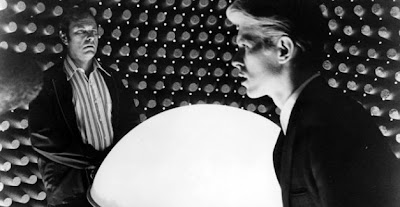
Bowie's space connection would continue, of course, with his Ziggy alter-ego, songs like Starman and Moonage Daydream, and his lead role-as-alien in The Man Who Fell to Earth (1976/movie still above). Space Oddity's 'Major Tom' would re-appear in the songs Ashes to Ashes and Hallo Spaceboy. Bowie's son, Duncan Jones, has continued the family motif with his excellent feature film debut, Moon (2009). It's time to re-explore David Bowie. Suggested listening: David Bowie, *Hunky Dory, Low, Heroes, Lodger, Storytellers, Ziggy Stardust, Aladdin Sane, Outside. Spy Vibers can also re-mix Bowie's Space Oddity, which you can find as an app in the iTunes app store.
Recommended reading: Bowie, a Biography by music journalist, Marc Spitz. I'm reading the kindle edition now! Marc's website here. Review of the upcoming archive-book about Bowie's early years, Any Day Now, here.

December 10, 2010
007 MISSIONS
With talk of the new Bond film possibly getting back into production, it's made me nostalgic for the past missions. I always loved the title sequence in On Her Majesty's Secret Service because they used a clip-reel of cool moments from the earlier films to help audiences make the transition from Connery to Lazenby. As a young fan, it was almost like seeing the start of a cliffhanger serial and having my excitement and anticipation wound up again before the show. Happy Friday!
December 9, 2010
JAMES BOND MUSEUM PLANS
If you can't make it far north of London to see the James Bond Museum in Keswick, you might just get your chance to see the Ian Fleming Foundation's very own prized collection of 007 vehicles and spy artifacts at a site about 50 miles south of Chicago. At the museum project's website, you can view a sideshow of the proposed space and even make donations to help the project move forward. The plan is to open in 2012 during the 50th anniversary of the first Bond feature film, Dr. No. 007 insiders have hinted that the film franchise may also be back and running to release the next Bond film in 2012. All Spy Vibe fingers are crossed. Additional info at Wired here.
 The Foundation collection includes:
Goldfinger (1964) – Lockheed Martin VC-140B Jet Star scale model
Thunderball (1965) – Tow Sled, RAF Vulcan Bomber model
You Only Live Twice (1967) – Model 45 Bell Helicopter model
On Her Majesty’s Secret Service (1969)– Tracey’s 1969 Mercury Cougar XR7, 428 Cobra Jet Convertible
Diamonds Are Forever (1971)– Ford Mustang Mach 1 429 Cobra Jet, Bath-O-Sub, Honda ATV-90
Live and Let Die (1973) – Glastron Chase / Jump Boat, Glastron Chase Boat
The Man With the Golden Gun (1974) – AMC Hornet
The Spy Who Loved Me (1977) – Lotus Submarine Car, Wetbike Water Cycle
Moonraker (1979) – Glastron Amazon Chase Boat
For Your Eyes Only (1981) – CV3 Citroen, Neptune Submarine
Octopussy (1983) – Auto-Rickshaw, “Tuk-Tuk”
A View to a Kill (1985) – Renault Taxi
The Living Daylights (1987) – Aston Martin Volante
License to Kill (1989) – Villains’ Kenworth Truck
Goldeneye (1995) – Cagiva Motorcycle
Tomorrow Never Dies (1997) – BMW R 1200 C Motorcycle
The World Is Not Enough (1999) – “Q’s” Jet Boat, Villains’ Land Parahawks and Flying Parahawk
Die Another Day (2002) – Jaguar XKR, Bombardier Rev 800 MXZ Ski-Doos, Switchblade
Casino Royale (2006) – Ford Mondeo
UK SATIRE/SURREALISM: PETER SELLERS TO JOHN LENNON
In honor of John Lennon's memorial yesterday, here is a Spy Vibe post about the Satire/Surrealism boom in the UK. From Peter Sellers and Peter Cook, to John Lennon and Monty Python. Enjoy!
The rare spy show, The Corridor People (1966), is now available on DVD from Network. As Tanner wrote in his excellent review at Double O Section, the show's four episodes draw on elements of the theater of the absurd, and things can get pretty weird! If you wonder just how "far out" it gets, Tanner mentions the final episode of The Prisoner, Fallout, as an example. Press releases for The Corridor People often mention similarities to The Avengers and Monty Python. But looking at the promotional clip below, I think it will help viewers to appreciate The Corridor People more by taking a quick look at the larger context of the surrealism and satire boom in 1960s England. We'll save the preview of The Corridor People for the end. No peeking!

Satire Boom
With the rise of youth culture and a questioning of traditional class roles, social satire became the new frontier in late 1950s/early 1960s British humor. Following in the footsteps of Peter Sellers and The Goons, who offered a wild send-up of British characters and institutions, young comedians like Peter Cook and Dudley Moore of Beyond the Fringe and the future members of Monty Python became the acerbic voice of the generation. Some of the popular targets included class, the generation gap, authority, official media, media styles/conventions, education, family, and the job market. Comedy fans may recall Beyond the Fringe skits like The Great Train Robbery, Sitting on the Bench, and my fave below, One Leg Too Few. Film fans may remember John Schlesinger's Billy Liar (Tom Courtenay/1963) for its blend of satire and fantasy. John Lennon played a key role in this satirical climate, with his James Thurber-like published books of cartoons and poetry, In His Own Write (1964) and A Spaniard in the Works (1965).

Surrealism Boom
Surrealism experienced a rather major renaissance in the early-mid 1960s. Long before the mind-altering psychedelia that we associate with the 1960s was introduced, influential artists like John Lennon were already thinking outside the box. Inspired by the surrealism of Lewis Carroll, Lennon and others challenged the status quo with a playful and eschewed view. One figure who loomed large in this movement was an American ex-pat in London named Richard Lester, who had worked with the Goons on television projects. At the dawn of the sixties, he collaborated with Peter Sellers and Spike Milligan on a short film called the Running Jumping & Standing Still Film (1960). John Lennon, a fan of The Goons, loved the movie and kept Lester in mind when it came time for The Beatles to make a motion picture. Seeing a clip from Running Jumping below, I'm sure Spy Vibers will recognize a gag which echoed through Monty Python skits years later. Fish-Slapping dance anyone?
Richard Lester was picked to direct The Beatles in A Hard Day's Night (1964), also groundbreaking for its surreal segments, and he continued to helm the films, Help! (The Beatles/1965) and How I Won the War (Tom Courtenay/John Lennon/1967). Lester also teamed with James Bond composer, John Barry, in two major pieces for the 1960s, The Knack... and How to Get it (Rita Tushingham/1965) and Petulia (Julie Christie/1968). Fans of The Monkees might recognize a scene inspired by The Knack, where the characters wheel a bed through traffic.
Lewis Carroll
As I mentioned, the surreal and whimsical work of Lewis Carroll (1832-1898) resonated throughout the Arts in early-mid sixties England. John Lennon often listed the author as a big influence on his own imagery (see I am the Walrus below). A notable celebration of Lewis Carroll came in 1966 with the BBC's production of The Wednesday Play. With a soundtrack by Ravi Shankar, this surreal Alice film starred a who's who of British talent, including Peter Sellers, Wilfrid Brambell, Leo McKern, Sir Michael Redgrave, Eric Idle (Monty Python), Sir John Gielgud, and all four members of Beyond the Fringe, Peter Cook, Dudley Moore, Alan Bennett, and writer/director, Jonathan Miller. Spy Vibers will recognize a number of actors in the film for their appearances in the satirical/surreal spy shows, The Avengers and The Prisoner.
The 4th Wall
An element that is pointed out when discussing the performance style of The Corridor People is the breaking of the fourth wall, or when actors speak directly to the audience. This was not a new technique. Eugene O'Neill is one playwright who employed it in his play, Strange Interlude. This was parodied in the 1930s by the Marx Brothers, where Groucho actually speaks of "corridors." The convention was also seen in the wartime and post-war comedies of Bob Hope and Warner Brothers animation studio. The sudden, snappy interplay between character and viewer was hip again in the 1960s and seen often in British films. This convention of storytelling had an element of participation that I believe created a deeper level of engagement with the largely young audience. Where we watched Truffaut's Julie Christie interact on-screen with a TV soap opera in Fahrenheit 451 (1966), films like Alfie (1966), How I Won the War (1967), and The Knack...and How to Get it (1965) actually put the movie-going viewer right into the action.
Additional Viewing
Essential faves from the satire/surrealism boom also include The Wrong Box (Michael Caine/Peter Cook/Dudley Moore/1966) Monty Python's Flying Circus (1969-1974), Not Only But Also (Peter Cook/Dudley Moore/1965-1970), Bedazzled (Peter Cook/Dudley Moore/1967), The Rise and Rise of Michael Rimmer (Peter Cook/1970), and below: The Bed Sitting Room (Richard Lester/Peter Cook/Rita Tushingham/1969) and Magical Mystery Tour (The Beatles/1967).
The Corridor People
Now that you have a larger context of the satire/surrealism boom in 1960s England, take a look at the promo trailer for The Corridor People below. With an appreciation for the satirical and surrealist approach, I think Spy Vibers will also enjoy the added spy elements in the show. I particularly enjoy the silencer in the baby carriage! Again, the complete four-episode set is available from Network here. Linked words in this post will lead to related video clips and media.
The rare spy show, The Corridor People (1966), is now available on DVD from Network. As Tanner wrote in his excellent review at Double O Section, the show's four episodes draw on elements of the theater of the absurd, and things can get pretty weird! If you wonder just how "far out" it gets, Tanner mentions the final episode of The Prisoner, Fallout, as an example. Press releases for The Corridor People often mention similarities to The Avengers and Monty Python. But looking at the promotional clip below, I think it will help viewers to appreciate The Corridor People more by taking a quick look at the larger context of the surrealism and satire boom in 1960s England. We'll save the preview of The Corridor People for the end. No peeking!

Satire Boom
With the rise of youth culture and a questioning of traditional class roles, social satire became the new frontier in late 1950s/early 1960s British humor. Following in the footsteps of Peter Sellers and The Goons, who offered a wild send-up of British characters and institutions, young comedians like Peter Cook and Dudley Moore of Beyond the Fringe and the future members of Monty Python became the acerbic voice of the generation. Some of the popular targets included class, the generation gap, authority, official media, media styles/conventions, education, family, and the job market. Comedy fans may recall Beyond the Fringe skits like The Great Train Robbery, Sitting on the Bench, and my fave below, One Leg Too Few. Film fans may remember John Schlesinger's Billy Liar (Tom Courtenay/1963) for its blend of satire and fantasy. John Lennon played a key role in this satirical climate, with his James Thurber-like published books of cartoons and poetry, In His Own Write (1964) and A Spaniard in the Works (1965).

Surrealism Boom
Surrealism experienced a rather major renaissance in the early-mid 1960s. Long before the mind-altering psychedelia that we associate with the 1960s was introduced, influential artists like John Lennon were already thinking outside the box. Inspired by the surrealism of Lewis Carroll, Lennon and others challenged the status quo with a playful and eschewed view. One figure who loomed large in this movement was an American ex-pat in London named Richard Lester, who had worked with the Goons on television projects. At the dawn of the sixties, he collaborated with Peter Sellers and Spike Milligan on a short film called the Running Jumping & Standing Still Film (1960). John Lennon, a fan of The Goons, loved the movie and kept Lester in mind when it came time for The Beatles to make a motion picture. Seeing a clip from Running Jumping below, I'm sure Spy Vibers will recognize a gag which echoed through Monty Python skits years later. Fish-Slapping dance anyone?
Lewis Carroll
As I mentioned, the surreal and whimsical work of Lewis Carroll (1832-1898) resonated throughout the Arts in early-mid sixties England. John Lennon often listed the author as a big influence on his own imagery (see I am the Walrus below). A notable celebration of Lewis Carroll came in 1966 with the BBC's production of The Wednesday Play. With a soundtrack by Ravi Shankar, this surreal Alice film starred a who's who of British talent, including Peter Sellers, Wilfrid Brambell, Leo McKern, Sir Michael Redgrave, Eric Idle (Monty Python), Sir John Gielgud, and all four members of Beyond the Fringe, Peter Cook, Dudley Moore, Alan Bennett, and writer/director, Jonathan Miller. Spy Vibers will recognize a number of actors in the film for their appearances in the satirical/surreal spy shows, The Avengers and The Prisoner.
The 4th Wall
An element that is pointed out when discussing the performance style of The Corridor People is the breaking of the fourth wall, or when actors speak directly to the audience. This was not a new technique. Eugene O'Neill is one playwright who employed it in his play, Strange Interlude. This was parodied in the 1930s by the Marx Brothers, where Groucho actually speaks of "corridors." The convention was also seen in the wartime and post-war comedies of Bob Hope and Warner Brothers animation studio. The sudden, snappy interplay between character and viewer was hip again in the 1960s and seen often in British films. This convention of storytelling had an element of participation that I believe created a deeper level of engagement with the largely young audience. Where we watched Truffaut's Julie Christie interact on-screen with a TV soap opera in Fahrenheit 451 (1966), films like Alfie (1966), How I Won the War (1967), and The Knack...and How to Get it (1965) actually put the movie-going viewer right into the action.
Additional Viewing
Essential faves from the satire/surrealism boom also include The Wrong Box (Michael Caine/Peter Cook/Dudley Moore/1966) Monty Python's Flying Circus (1969-1974), Not Only But Also (Peter Cook/Dudley Moore/1965-1970), Bedazzled (Peter Cook/Dudley Moore/1967), The Rise and Rise of Michael Rimmer (Peter Cook/1970), and below: The Bed Sitting Room (Richard Lester/Peter Cook/Rita Tushingham/1969) and Magical Mystery Tour (The Beatles/1967).
The Corridor People
Now that you have a larger context of the satire/surrealism boom in 1960s England, take a look at the promo trailer for The Corridor People below. With an appreciation for the satirical and surrealist approach, I think Spy Vibers will also enjoy the added spy elements in the show. I particularly enjoy the silencer in the baby carriage! Again, the complete four-episode set is available from Network here. Linked words in this post will lead to related video clips and media.
December 8, 2010
JOHN LENNON REMEMBERED
It was thirty years ago today that we lost John Lennon. I remember the day well. I was away at boarding school in Vermont. The daily trek up a steep field to campus was getting easier. Our dining hall was massive and barn-like, with post and beam exposed wood. Giant windows looked south toward campus, and on the north side, toward a stunning view of rolling hills and apple orchards. As I passed the double doors that led into the kitchen, I spotted the little chalk board at the opposite end of the room by the stove. One of the cook's must have heard the news on the radio. It was just a brief message that John had died. Was it a joke? Or maybe some kind of stunt? For a few seconds, I couldn't really accept the news. But then I heard that our classmate and friend, a nephew of Yoko's, had rushed away to be with family. I remember that all of us spent the day in a kind of shock, thinking of our friend's loss and trying to fathom the greater loss to the world.

Remember John today. What was your first encounter with John Lennon as artist or activist? Do you remember the first time you heard his voice? What was the song? The first record I ever owned (that wasn't a children's album), was The Beatles Help. A friend of my dad's passed it down to me. I'm sure I heard the Let it Be album before this, but my first real memory of listening to his songs is playing Help over and over as a 5 or 6 year old. I had the US soundtrack version with the "James Bond" intro to the title track. Maybe that single experience is responsible for both The Beatles and James Bond in my life now? I also recall my imagination being really sparked by the photography on the record jacket, and later by the music and fashion in the film. There was something about that mid-1960s period that caught my eye then, and it continues to seduce me. And of course, I've spent the rest of my life learning about John's work and ideas. His impact on people and culture around the globe is unmeasurable.

Rolling Stone has printed their last interview with John. The website has a digital companion page to the piece, where you can access additional content, including video and audio files. Yoko encourages us to do something positive today. She has also shared a nice memory of having tea and enjoying daily life with John on her website. She invites others to contribute. Yoko Ono site here. My sound/film collage tribute to John and my experimental film/re-mix for Yoko Ono on my Youtube channel here. Read Spy Vibe's article about the surreal/satire boom in 1960s UK (with John Lennon!) here. Portrait still from Help! from the Beatles Photo blog here.
December 6, 2010
MRS PEEL, WE'RE STREAMING
Saving the world in style- on the internet. Fans of The Avengers who are looking for new ways to catch John Steed, Emma Peel, and Tara King in action will be happy to hear that Netflix now offers streaming episodes of the 1967 season (Diana Rigg) and the 1968 season (Linda Thorson). Spy Vibers with a Netflix account can now watch unlimited episodes at a low cost, including classics like Return of the Cybernauts (Peter Cushing), The Living Dead, Never Never Say Die (Christopher Lee), and Fog. Hopefully we will see additional seasons added to their on-line content. If you know a budding Spy Viber who has never seen The Avengers, this may be a good way to pass this cult classic on to a new generation.

In the mood for more stylish adventure? Check out Spy Vibe's fashion articles Peeling Off the Trench Coats and Mods to Moongirls. Spy Vibe's Jason Whiton goes Nehru here. Cold War Fear & Fashion here.


In the mood for more stylish adventure? Check out Spy Vibe's fashion articles Peeling Off the Trench Coats and Mods to Moongirls. Spy Vibe's Jason Whiton goes Nehru here. Cold War Fear & Fashion here.

December 5, 2010
BO DIDDLEY: FLASHBACK
Enjoy the start to your week with a Spy Vibe flashback. Last summer we celebrated the signature beat of Bo Diddley and looked at how his partnership with female musicians and his choice of guitars echoed the women's liberation movement and space-age designs of the early-mid 1960s. Grab your Gretsch Jupiter, hop on that scooter, and let's go for a ride!
Meet Bo Diddley & the Duchess
Space Age Guitars
Road Runner
Hey Bo Diddley
Shindig
The Duchess & Liberation
 Spy Vibers interested in seeing more about Shindig, Hollywood a Go Go, and Go Go dancers should check out the Spy Vibe archives from June 2010. Shake it up.
Meet Bo Diddley & the Duchess
Space Age Guitars
Road Runner
Hey Bo Diddley
Shindig
The Duchess & Liberation
 Spy Vibers interested in seeing more about Shindig, Hollywood a Go Go, and Go Go dancers should check out the Spy Vibe archives from June 2010. Shake it up.
LAND OF THE GIANTS: PRICE DROP
Heads up to fans of Irwin Allen's cult 1960s TV shows (Lost in Space, Time Tunnel, Voyage to the Bottom of the Sea): The incredible box set of the complete Land of the Giants series has dropped in price on Amazon. The set is currently around $120 (down from its usual price around $230). The package design is similar to the U.N.C.L.E. DVD set in that the box takes on a thematic form based on the series. In this case, a small cage that shows our lilliputian heroes trapped inside. Reviews state that the transfers are excellent (individual episodes can be purchased for streaming), and the box contains a huge collection of vintage-style memorabilia and bonus features. Spy Vibe recommends! Amazon page here. For more Irwin Allen fun, check out the fantastic books from Hermes Press, including reprints of 1960s Gold Key comics and behind-the-scenes coffee table books. Hermes website here. In addition, be on the lookout for the January 11th release of Voyage to the Bottom of the Sea Season Four, volume 2 on DVD (Amazon page here).


JAMES BOND DRINKS
James Bond creator, Ian Fleming, was famous for his enthusiasm for the finer things in life, especially the sensory experiences of food and drink. His novels are filled with descriptive moments where 007 takes note of the quality of a fine blend and the alchemy of a gourmet menu. As a reader and viewer, I've found these details fascinating, and I appreciate the function they serve in creating the Bond character. 007 has a developed palate and an eye for good-taste, qualities that make him a fun agent to hang out with. He is exacting and decisive. "Shaken- not stirred." His choices echo the prowess he shows as a spy and man of action/romance. Though my tastes lean more toward the fashion, architecture, gadgetry, and design of Fleming's creation, Keith at Teleport City has written an interesting article about the particular role that alcohol has played in the world of James Bond. Check it out here.


December 2, 2010
007 LIMITED EDITION PRINTS
My fellow COBRAS blog, Illustrated 007, has posted many amazing images from the world of James Bond. Its archives are like a virtual museum of Bond art and artists. Today our man Peter at the blog alerted us to the special news that illustrator, Robert McGinnis has a series of limited edition signed prints for sale. McGinnis is perhaps most well-known among Spy Vibers for his poster illustrations for the 007 film, Thunderball (1965), as well as poster art for Barbarella (1968) and Breakfast at Tiffany's (1961). If you ever fantasized about having signed classic 007 images by the master himself, now is your chance.

There are a few Thunderball-related illustrations and more to explore. Each 17x23 print from the Hollywood Edition is around $210. Collectors who order two or more prints receive an additional sketch print by McGinnis that shows some of his process. From what Peter has shown from his collection, I can say that these are very beautiful illustrations that evoke iconic, 1960s Spy Vibe elements of secret agents, seduction, fashion, and mystery/adventure thrills. Did I mention spy girls with spear guns? Alert for younger readers: illustrations do contain nudity. Details about the Robert McGinnis Hollywood Edition here.


There are a few Thunderball-related illustrations and more to explore. Each 17x23 print from the Hollywood Edition is around $210. Collectors who order two or more prints receive an additional sketch print by McGinnis that shows some of his process. From what Peter has shown from his collection, I can say that these are very beautiful illustrations that evoke iconic, 1960s Spy Vibe elements of secret agents, seduction, fashion, and mystery/adventure thrills. Did I mention spy girls with spear guns? Alert for younger readers: illustrations do contain nudity. Details about the Robert McGinnis Hollywood Edition here.

Subscribe to:
Posts (Atom)