One of my favorite artists, Ryan Heshka, creates paintings, prints, and limited-edition comics which channel a strong vibe of classic pulps, sci-fi, and comic books. He has a new "Batman vs. the Bog Mummy" print available that Spy Vibers might enjoy. See here. Main store site here. Heshka stopped by the Spy Vibe lair some years back to chat about his imagery and about some of his favorite characters and influences. Here is our interview.
Welcome, Ryan! Your work seems to channel a kind of surreal interpretation of classic cover illustrations from the Pulps and early Sci-Fi paperbacks. What do you love about this kind of imagery?
When I was a kid, it was strictly about the “cool” monsters, spaceships and aliens. But the long-term appeal for me is the visionary aspect of the work, and the sense of wonder instilled in the imagery. In the early days of pulps and science fiction, there was no guidebook to how this material should look, and artists were able to run wild and create some truly memorable visuals. I enjoy looking at art forms in their infancy, when exploration and experimentation is pushed.
Do you have a collection of old books, comics, or pulps that you use for inspiration or reference? Do you keep a classic “morgue” of images?
Both. I don’t collect and buy like I did a few years ago, and recently sold much of my collection. But I still have a small, core collection of comics, pulps, and antiques. I also have hundreds of digital images that serve as inspiration, or sometimes just eye candy.
Many of my readers grew up collecting old books and memorabilia. Did you have a collection as a kid?
Yes, but nothing really substantial until my uncle gave my brother and I his comic collection from the 1960’s, pretty much all Marvel, and mainly the Fantastic Four, which happened to be the title I collected. It was like finding gold. All of a sudden we had a kick ass comic collection, loaded with Kirby. As a kid, I could never afford to buy the 1940’s comics I wanted, but I sought out reprints of the expensive material.
I’m really looking forward to seeing the new Mean Girls Club comic. Without giving too much away, what can viewers expect to see in the work?
It’s a fairly simple, linear comic story, which depicts the Mean Girls acting out various acts of … meanness. Within the comic, I tried to incorporate as much twisted humor as I could to balance the sheer nastiness of these girls. Readers will witness fish slap fights, creeping living merkins, and a microscopic view of genital crabs. This comic is not for the weak of heart.
Tell us more about how Mean Girls got started. Did old comics or films inspire you?
"Mean Girls" definitely grew out of my life-long love of B- to Z-grade exploitation films, and crime and horror comics of the 1950’s. The whole concept grew out of one small sketch that I had painted in an old 1910 day timer. I doodle in this book when I have extra time and left over paint. I painted this angry looking girl with a unibrow, and a ghostly skeleton hovering behind her. The caption reads “it’s my brow, isn’t it?", like people’s look of horror could have nothing to do with this grim apparition behind her, this living embodiment of her anger. Shortly after that, I painted an entire line up of these mean girls. When the time came to figure out how I was going to fill the space at Wieden + Kennedy, I started mining that concept for more material, and built a world around them. I don’t think I am done with them yet.
I noticed the book was dedicated to Mike Vraney (founder of Something Weird Video). Was his work a big influence on you?
I met Mike several years back, and had the good fortune to hang out and see his collection. He and Something Weird were influences since the 1990’s, long before I met Mike. Amazing how paths can finally cross in life.
You’ve published some really interesting picture books in the past. Tell us about Welcome to MonsterTown, Welcome to Robot Town, and ABC Spookshow. If the Fleischer brothers made a Halloween cartoon, I think it would resemble the vibe of those “ghost writers” in Monster Town. It must have been fun to plan all those horror-inspired images.
Like the “Mean Girls” and many other projects, “Monster Town” and the ABC book were about as close as I could ever get to working for studios like the Fleischer Brothers, or early comics companies like Marvel in the 1940’s. They are sort of a fantasy working vacation. I grew up loving comics and cartons from WAY before my time, and I always felt like I should have worked in that era. I’m sure my romantic vision of those industries is a bit skewed, and I’m probably much better off working in the present.
I was introduced to your work through Chip Kidd, who posted that fabulous Batman painting you did (below). Although your work often has a Sci-Fi or Horror slant to it, there are also elements of Mystery and Adventure. Are you inspired by the detective Pulps and by things like early Batman?
Most definitely. I have always liked the mysterious, the eerie. I was into Batman from a very young age, and then really got into the early stories when I discovered the reprints of Batman’s pre-Robin days. His gun-toting days. Those early stories were simultaneously creepy and comedic at the same time. I got into crime pulp much later, and really appreciated the artistry of Norman Saunders and H.J. Ward.
Have you ever been into classic cliffhanger serials? Based on your work, I think you might enjoy chapter-films like Fantomas and The Crimson Ghost.
I have yet to see either of those, but thanks for the recommendation. From the stills and posters I have seen, they are right up my alley. I was aware of serials as a kid (pre-VHS days), but somehow I only ever saw a random chapter of a random serial. So when I was somewhere that had a tv that was running a serial chapter, I was glued. My favorite to this day is The Phantom Creeps with Bela Lugosi, and that big ugly robot with fangs and claws.
Ryan, if you were a diabolical mastermind or detective, what would your secret lair look like?
I have a degree in interior design, so it would have to be worthy of Architectural Digest. Very ultra-modern, sleek, dark and glossy. Slim metal details, and everything hidden away behind sliding panels. And a great view.
My family founded the New York School of Interior Design (quite an unusual idea during WWI!). I’m interested in your early training as a designer. Where did you study and how would you describe your style?
I studied at the University of Manitoba, and graduated in 1992. I only actually practiced professionally for about four years, before moving on to animation and then art and illustration, but it left a huge impact on me. I love mid-century modern and art deco. Contemporary design is also of interest to me. Like my taste in music, it either has to be from well before my time, or slightly beyond it.
How does that design training play into your painting and illustration? It seems like you pay special attention to color, composition, and the vibe of each piece.
That is very true, and I also set up many paintings to feature furniture, or industrial design such as telephones or lights. Sometimes the people in the painting are merely there as an excuse to paint a beautiful chair or weird table. The furniture often is a character as much as a human figure. I love details, and detail is a great device to suck people into your artwork. Detail pulls people in, and gives the image depth and life. Much like a well-built piece of furniture… it should be fascinating and yet comfortable. You should want to spend some time in it.
I really enjoy your use of text in your pieces. Do you remember how you came upon that idea as a common thread through your art?
I don’t really recall when I first used the clippings. I do know that decades ago, I salvaged stacks of pages from my Grandpa’s dry cleaning shop ledgers, not being sure what I wanted to use them for. These much later became the surfaces for my personal paintings. When I applied varnish to the finished acrylic painting, the ball point pen would seep through to the surface, and ghostly names from my family’s past would appear. So this doesn’t really answer your question, but is another type of found typography that appears in my work.
Are there other elements or conventions, perhaps from genre fiction or comics, which you enjoy adding to your work?
If I have an interesting dream, I will often use elements from the dream to create imagery. An early example of this is the painting “GOLLY”. I dreamt about this odd magazine, that featured on the cover a giant ,weird, googly-eyed bat carrying off a passenger plane. This painting was pretty much an exact replica of the magazine in my dream. When I don’t have interesting dreams, I paint things I would want to dream about.
What are the steps you go through to plan your pieces?
Often a piece or a series will start as random sketchbook entries, which I will then develop as rough thumbnail layouts. From there, I may bring them into a tighter sketch form. If I am very comfortable with the idea, I will often just go straight into the painting, in order to maintain the spontaneity of the idea.
I read that you made cardboard cities as a kid. I’d love to see photos! Do you still make them? Do you like to design sets? Agnes Varda made a wonderful movie called Jacquot de Nantes about her husband, Jaccques Demy, that included his homemade towns and super 8 films he made as a child. You might enjoy it.
I will be sure to check that out. I don’t have any photos of my childhood cities handy. Not many exist. I built some very small scale, intricate cities as a child, and regret not having any foresight to document them. I don’t have time to build cardboard civilizations any more, but my wife and some friends and I did build a stop motion table top set, which became the setting for the stop motion sequences in the “Mean Girls Club” film. If I had more free time, that would be a great hobby. I hear that the comic artist Seth is building an entire model city from scratch in his basement.
When you were starting out as a painter/illustrator, who were the artists who inspired you?
I always cite Frank R. Paul, the grandfather of science fiction art, as one of my major influences. Jack Kirby is another one. Specifically when I began looking at illustration as a career, I was very into Mark Ryden, Camille Rose Garcia, Gary Basemen, the Clayton Brothers… I still love the work of these and many other artists based out of LA. Marcel Dzama, the Royal Art Lodge and Neo Rauch also blew my mind. Of course, there were also comic artists from the golden age, too numerous to mention.
Readers in the Portland, Oregon area can see your current installation until July 31st. Tell us about the exhibit. Does it include your illustration work, or is it more of a “fine art” experience?
It is designed as an installation. There are some prints, silk screens and paintings in the back area, but all the new work is in the installation. The entire show was an excuse to try things I had never done before (music, large murals, a human-scaled built object), or work in mediums that I favored in my youth (like the comic and film). The build out of the clubhouse and much of the installation was constructed by the studio crew at Wieden + Kennedy, and it was the first time I had a “staff” bringing my vision to life. That in itself was surreal, considering I have worked alone for the last 15 years. The show was an exhilarating experience. I was extremely lucky to have had such an opportunity. What are some of your all-time favorite cover illustrations from paperbacks and the Pulps?
The December 1926 issue of Amazing Stories is my all-time favorite cover. Also the classic Paul “War of the Worlds” Amazing Stories cover from 1927. So many great pulp covers, I can’t even begin to list them all. Almost anything by Margaret Brundage for Weird Tales in the 1930’s is worth looking at!
What are some of your favorite classic comics and comic images?
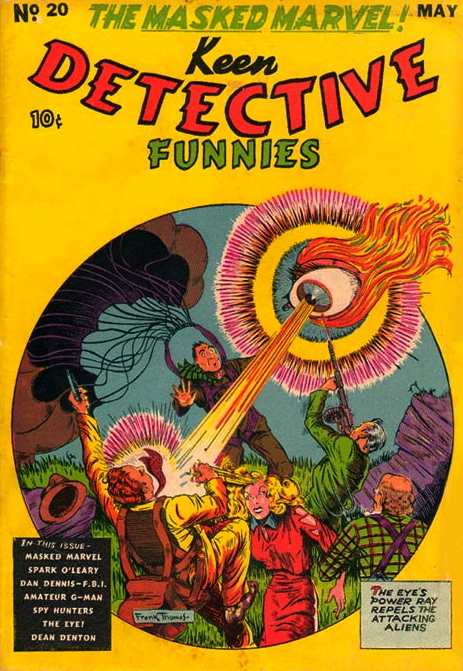
Bill Everett’s Amazing-Man run is brilliant. The cover to Marvel Comics #1 gives me goose bumps. Keen Detective Funnies #20, with “the Eye Sees” cover is about as good as it gets. The Eye is literally just a large disembodied eyeball that blasts people with a death ray. Any of the Batman stories from Detective Comics #27 to 37 are worth a read. The dramatic space comic strips by Basil Wolverton are favorites of mine. Lately, due to the rising cost of vintage comics, I have begun collecting original content vintage foreign comics, which are a fraction of the price of American comics, and often have way more interesting artwork.
Are there upcoming projects you can talk about?
After taking about two years off from painting shows, I am starting to plan and prep my next art show, which opens in Milan at the Antonio Colombo Gallery in April 2015. I have my first show in London at the Atomica Gallery in the Fall of 2015. I’m looking forward to painting again. I’m also hoping to do some more comics projects at some point; I guess I’ll see where the Mean Girls Club comic takes me.


Selected Spy Vibe Posts: William Klein R.I.P., Spy Vibe Radio: M Squad, Spy Vibe Radio: Mr. Broadway, Agent King, Paul at 80, Spy Vibe Radio: John Kling, Classical Cold War, Spy Vibe Radio: Unknown Man of Shandigor, Danger Man Podcast, Spy Vibe Radio: Dr. Mabuse, Bowie Day, Interview: Girls Guns Gadgets, Shandigor Blu, Shag Palm Springs, New Bond Novel, Hi-Fi Book, Judex Serial Blu, UFO Comics, Interview: John Buss, ITC Magazine, Interview: Kaiser Marionettes, Belmondo R.I.P., 007 Corgi Event, Space 1999: The Vault, Shag Eames Lounge, Firecracker Exotica, Spy Vibe Radio: Lola Albright, Tikyaki 5-0, Godzilla Scores, Mid-Century Village, Spy Vibe radio: Nicola Conte, Men's Adventure Quarterly, Billy May Frenesi, Gary Numan, Spy Vader Spy, Chris Barber Legacy, Phantom Retrospective, Astro-Man, Spy Vibe Radio: Batman, James Bond Lexicon, Ray Cathode, Spy Vibe Radio: Johnny Staccato, Matt Helm Blu, Cold War Auction, Avengers Francavilla Prints, Avengers 60th Event, Irma Vep Blu, Avengers Keel Design, Ronnie Scott's Doc, The Avengers 60th Design, Art of Pan Books, John Le Carre R.I.P., Sean Connery R.I.P., New 007 Vinyl, Burke's Law Ska, Dieter Rams Complete, 2-Tone Doc, Spy Vibe Radio: Vendetta Part 2, Diana Rigg R.I.P., Moog Micky Dolenz, Beetle Bailey 70th, RSD Spies Vinyl, Ian Fleming Tribute, Fellini Box Set, Spy Vibe Radio: Vendetta, The Saint Podcast Bonus, The Saint Podcast, Barber Lotus, Trad Roots, Morricone R.I.P., Fleetway Spy Designs, John Steel Casebooks, ITC Podcast: The Persuaders, Dazzle Ships, Spy Vibe Radio: Raumpatrouille, Remembering Richard Sala, Crime & Spy Jazz books, Numan is FAB, Bruce Lee Blu, RSD Vinyl Spies, James Bond's DB5, UFO CD Set, Spy Vibe radio: Phantom Agents, Steranko is Revolutionary!, Interview: The Saint I Ain't, Diabolik Interview, New 007 Song, Diabolik Figures, Diabolik Sounds, Diabolik Set Design, Diabolik Park Ride, Danger Diabolik Blu, Count Arthur Strong, Honey West Title Cards, Bowie Day, Neil Innes R.I.P., Claudine Auger R.I.P., OHMSS at 50, Italian Job 50th OST, Charles Schulz Modern, Paul Desmond, Python 50th, Randall Hopkirk 50th, Thunderbirds Day, Lazenby Returns to MI6, Dr. John R.I.P., Spy Vibe Radio: Lupin III, Lupin Ska, Spy Vibe Prime, Zigomar Translation, The Village: Part 1, Monkey Punch R.I.P., Bubble Girl 63, ITC Soundtracks, Spy Vibe Radio: Public Eye, UFO Prime, Spaceship to Mars, Modesty Blaise Companion, Spy Vibe Radio: Fantomas, George Day, Fantomas Blu, Dark Shadows Doc, Bedazzled Blu-ray, Mary Quant Exhibit, Laika Calypso, Lost in Space Japan, Spy Dust Calypso, Atomic Cafe, John Barry Mono, Interview: John Barry Book, Land of the Giants Score, Spy Vibe Radio: Upperseven, Mabuse Propaganda, Bond Beatles Day, Spy Vibe Radio: Liquidator, Diabolik LP, Fab Dresses, Eurospy Music Collection, Beetle Bailey in West Berlin, Why Mort Walker?, Spy Vibe radio: The Beatles Help!, Avengers Critical Guide, The Spotnicks, Benny Spies, James Pond 0017', Satire Stones, Annette Andre Book, Spy Vibe Radio: Get Smart, Caine: My Generation, Interview: Ian Ogilvy, Horror of Party Beach, Sylvie Vartan Renown, Ringo At 78, Dark Shadows Strips, Spy Vibe Radio: Flint, Archie Batman 66, Beatles Pac-Man, Spy Vibe Radio: Jerry Cotton, The Invaders, 007 Horowitz Book Tour, The Prisoner Interviews Vol 1, British Underground Press, Interview: Fab4 Mania, Bond Cocktail Book, Spy Smasher, Spy Vibe Radio: Peter Gunn, Agent Zero M, New Prisoner Comic, Dr. No Villains Edition, Spy Vibe Radio: Danger Diabolik, Dr. No 60th, Oy-Oy-Seven, Spy Vibe Radio (UFO), Cold War Comic Strips, Mission to India, Mort Walker Celebration, Peter Wyngarde Celebration, Ian Fleming Publications 2017-2018, Interview: Ed Hulse Pulp, Avengers Audio Drama, Interview: Callan At 50, Interview: Playboys, Spies, Private Eyes, TWA Returns, Spy Vibe Radio 8, Interview: Ryan Heshka, Mid-Century Modern Schulz, Agent Werewolf, Johnny Sokko 50th, Interview: Trina Robbins, Eddie Izzard, The Prisoner Capt Scarlet 50th, Hugh Hefner R.I.P., Jack Good R.I.P., Interview: Shaken Not Stirred, Callan 50th, Spy Vibe Radio 7, Bo Diddley, Carnaby Pop, Billy Bragg Skiffle, Elvis 68, Jack Kirby The Prisoner, Review: The Prisoner Vol 2, Interview: The Prisoner Essential Guide, Maud Russell Mottisfont, Spy Vibe Radio 4, Batman Gallants, Adam West R.I.P., Village Triangle, Roger Moore R.I.P., Spy Vibe Radio 3, Sgt Pepper 50th, Satanik Kriminal OST, 60s Overdrive, Spy Vibe Radio 2, Spy Vibe Radio 1, James Bond Strips, Interview: Police Surgeon, XTC Avengers, 1966 Pep Spies, Batman Book Interview, Exclusive Fleming Interview, Avengers Comic Strips, Robert Vaughn RIP, UNCLE Fashions, Thunderbirds Are Pop!, Interview: Spy Film Guide, Lost Avengers Found, The Callan File, Mission Impossible 50th, Green Hornet 50th, Star Trek 50th, Portmeirion Photography 1, Filming the Prisoner, Ian Fleming Grave, Revolver at 50, Karen Romanko Interview, Mod Tales 2, Umbrella Man: Patrick Macnee, New Beatles Film, The Curious Camera, Esterel Fashion 1966, Exclusive Ian Ogilvy Interview, 007 Tribute Covers, Argoman Design, Sylvia Anderson R.I.P., Ken Adam R.I.P., George Martin R.I.P., The New Avengers Comics, 007 Manga, Avengerworld Book, Diana Rigg Auto Show, The Prisoner Audio Drama Review.