Showing posts with label folk. Show all posts

June 9, 2017

VILLAGE TRIANGLE

Happy Friday, Spy Vibers! I've been doing some music-related research this week and came across some interesting connections. Whether it was Paul Simon, Pink Floyd, Bob Dylan, or Pete Seeger, I found myself being oddly drawn back to Greenwich Village. It all began with a TV special Simon and Garfunkel did in 1969 called Songs of America. It was directed by actor Charles Grodin and his intentions were to capture the social and political landscape of the times in order to provide context for Paul Simon's lyrics. He included scenes of poverty, race riots, and the funerals of Jack and Bobby Kennedy and Martin Luther King Jr. Fearing political backlash from southern viewers, the sponsor actually pulled out of the project. Set mostly to the songs from Bridge Over Troubled Water, the program also included a collage of interviews, recording sessions, and scenes of Simon and Garfunkel walking around New York. At one point they stopped in front the Folkways office, and then in front of a theater. The moment went by in a second, but my curiosity needed to be satisfied. What was the theater? I'm too much of a detective to let something like that pass. I re-watched the clip on slo-mo and was able to make out the Waverly Theater, which is in Greenwich Village. The film listed on the marquee was The Spy Who Came in From the Cold starring Richard Burton and Oscar Werner. Since the movie, based on the John le Carre novel, came out in 1965, I could only surmise the clip was either something S & G had in their archives, or the Waverly was doing a repeat screening. Regardless, it was pretty neat to spot that detail. And I was reminded, of course, of Simon's line in America, which appeared on Bookends in 1968 (cover photo by Richard Avedon):

Playing games with the faces 
She said the man in the gabardine suit
Was a spy
I said Be careful
His bow tie is really a camera 

The Waverly, by the way, was famous for being the first theater to run midnight screenings of Rocky Horror Picture Show. The building was eventually abandoned and became derelict until a recent renovation and reopening by the IFC (nice to see happy endings for old theaters!). At the same time this week, I've been re-reading Bob Dylan's autobiography, so the Village has been vivid in my mind. But the connections continued! As I was watching the wonderful David Gilmour (Pink Floyd) documentary, Wider Horizons, this morning I was struck to hear that his parents moved to the Village permanently in 1965 (did they see Spy Who Came in From the Cold at the Waverly?), and that they had send David a few records from an earlier trip for his 16th birthday in March '62. Gilmour still owns the Newport Folk Festival records, which he showed on-screen. His parents also sent him Bob Dylan's first album (within a week of release) and Pete Seeger's guitar instruction records. So many great British musicians of that era found inspiration in skiffle, and from the players who launched the original folk and blues movement such as Pete Seeger and Leadbelly. It was cool to hear Gilmour reminisce about hearing Seeger's lessons as a kid, and pretty amazing to think that such simple steps like tuning and basic chords would lead to such iconic music. But there it was again, the Village. And connections kept coming. Gilmour then met up with Jamie MacColl (Bombay Bicycle Club) in the documentary to sing Wish You Were Here on stage. And there we were once again, back in the Village and the folk boom. If you didn't recognize the name, Jamie's grandfather was the very famous British singer and folklorist, Ewan MacColl, and his grandmother is none other than Peggy Seeger- sister of Pete Seeger. *added: And the icing on the cake? Gilmour and his band Jokers Wild played a gig at Great Shelford in Cambridge in October 1965. Who was also on the bill? The Pink Floyd and... Paul Simon. Lots of full-circle moments happening on my radar this week, all because I had to pause a video to find out what movie was playing in the background of a Simon and Garfunkel TV special. Here are my quick shots of the screen and a vintage photo as evidence. *Added connections #2: It turns out my aunt and grandparents saw Spy Who Came in From the Cold at the Waverly in 1965! My aunt was twelve and said the film was frightening and that the rainy night added to the tone of the evening. Small world indeed! Related posts: Pete Seeger: R.I.P., Folk Boom, Pete Seeger Grammy, Dylan at Newport, Andy Warhol: 15 Minutes, 60s Overdrive, Make Love in London Psychedelic Celluloid, 60s Exposed. Spy Vibers, You can now hear my new radio segments with Cocktail Nation: Episode #1 (Danger Man) and Episode #2 (The 10th Victim), Epsiode #3 (On Her Majesty's Secret Service)Enjoy!


Selected Spy Vibe Posts: Roger Moore R.I.P.Spy Vibe Radio 3Sgt Pepper 50thSatanik Kriminal OST60s OverdriveMake Love in LondonSpy Vibe Radio 2Spy Vibe Radio 1James Bond StripsPropaganda MabuseFahrenheit 451 50thInterview: Police SurgeonXTC Avengers1966 Pep SpiesBatman Book InterviewExclusive Fleming InterviewAvengers Comic StripsRobert Vaughn RIPUNCLE FashionsThunderbirds Are Pop!, Interview:Spy Film GuideLost Avengers FoundThe Callan FileMission Impossible 50thGreen Hornet 50thStar Trek 50thPortmeirion Photography 1Filming the PrisonerGaiman McGinnins ProjectIan Fleming GraveRevolver at 50Karen Romanko InterviewMod Tales 2Umbrella Man: Patrick MacneeNew Beatles FilmThe Curious CameraEsterel Fashion 1966Exclusive Ian Ogilvy Interview007 Tribute CoversThe Phantom Avon novels returnIan Fleming FestivalArgoman DesignSylvia Anderson R.I.P.Ken Adam R.I.P.George Martin R.I.P.The New Avengers ComicsTrina Robbins InterviewThe Phantom at 80007 MangaAvengerworld BookDiana Rigg Auto ShowThe Prisoner Audio Drama ReviewDavid McCallum novelAndre Courreges R.I.P.Who's Talking on Spy VibeUFO Blu-rayAvengers Pop Art.

January 28, 2014

PETE SEEGER R.I.P.

Musician and activist Peter Seeger passed away yesterday at 94. Spy Vibe has celebrated Seeger in the past for his impact on the Folk Boom of the 1960s and for his life-long role as the Johnny Appleseed of song. Seeger was recently nominated for a Grammy Award for his new spoken-word album The Storm King. A collection of stories and poems from his life set to multi-genre music with percussionist Jeff Haynes, the album was great follow-up to two CDs he released last year-  not bad for a 94-year-old! Seeger grew up in a family of musicians who fostered a dedication to activism and traditional music. Seeger had a profound impact on the culture of the 20th Century through his gift for bringing people together through song. His long career stretches back to antifascist songs with Woody Guthrie during WWII, the Weavers, and decades of touring and playing on radio and television. As a website dedicated to 1960s style, Spy Vibe would be remiss if I didn't acknowledge the major influence Seeger had on the Folk Boom and on the political and spiritual climate of the decade. Even if you are not a fan of his style of music, Seeger represents a dedication to community and to the environment that I hope will prevail for years to come. The Grammy nomination was his fifth (he has won four times!), in addition to winning the National Medal of Arts, a Kennedy Center Honor, the Harvard Arts Medal, a Rock and Roll Hall of Fame induction, the Felix Varela Medal, the Peace Abbey Courage of Conscience Award, and the George Peabody Medal. Seeger sadly lost his wife Toshi last year after a 70-year marriage. His brother Mike Seeger (New Lost City Ramblers) passed away in 2009. His sister Peggy Seeger lives in the UK and continues to perform, record and speak out as an activist for LGBT rights and other issues. Below is a rare photo of Pete Seeger with Woody Guthrie. See more at NPR here. Story continues below. 


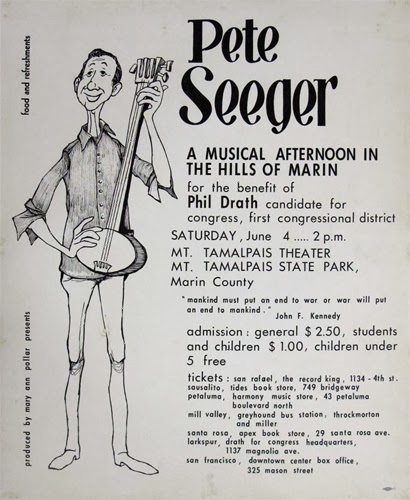
Recent related releases include Pete Seeger Remembers Woody and A More Perfect Union (with Emmylou Harris, Dar Wiliams, Steve Earle, and Bruce Springsteen), and a new documentary film called Greenwich Village: Music That Defined a Generation. Below is a rare poster for a benefit concert held in my backyard in Mill Valley, California in the late 1960s. Note the quote by John F. Kennedy. Other musicians supported Democratic candidate Phil Drath during the era, including the Grateful Dead and Joan Baez.


My eye on the early-mid 1960s has been particularly fascinated with the folk and blues boom. Not only is it interesting to see how youth culture embraced players like Pete Seeger, the music itself was powered by deep storytelling, humor, history, and topical concerns of the era. Pete Seeger was blacklisted during the McCarthy era, so maybe to that paranoid establishment, this was REAL "spy music." Spy Vibers might enjoy the video clips below of Pete Seeger. The Power of Song illustrates Seeger's commitment to bettering the world through music and captures some of the larger issues of the early 1960s. His song, Waist Deep in the Big Muddy, was performed on the Smothers Brothers show in 1967, but cut from broadcast by the censors. A campaign by the brothers pressured the network to finally air the footage, and Seeger was able to share a tune that showed his patriotism, empathy for those facing combat, and a larger questioning of war at the height of Vietnam. Written on his banjo were the words. "This machine surrounds hate and forces it to surrender." 


Another way to appreciate this area of music is to remember how important it was to the development of other styles. To stretch a quote by the great blues composer Willie Dixon, folks like Dylan, Seeger, Guthrie, Muddy Waters, Skip James, Lightnin' Hopkins, Sonny Terry, Lonnie Donegan, New Lost City Ramblers, etc were "the roots", and The Beatles, The Who, The Rolling Stones, Kinks, and Led Zeppelin were "the fruits". Maybe the folk crowd didn't sport Mod or Space-Age fashion, but they were true rebels of the period who stood for the things that really matter. One of the most memorable moments I've ever seen on TV was Pete Seeger on Hugh Hefner's Playboy's Penthouse (1959). Pete had a great talent for getting a crowd singing, and it was sweet to see a room of sophisticates huddled around him singing along. Hefner, a huge music fan himself, sat close to Pete and joined in. The guests were movers and shakers of the new cultural revolution, but unified in humanity by that banjo.


Spy Vibers interested in seeing another side of the early-mid 1960s should check out the great documentary, The Power of Song. The film offers a context to this man and his music that is quite moving. The spirit of Seeger's songs transcend time because they embody universal, human emotion and experience. I encourage all Spy Vibers to spend some time with characters like Pete Seeger, Bob Dylan, Alan Lomax. Dive into the Smithsonian Folkways site. Listen to traditional music from around the world and discover your inner folkie. Pete Seeger Appreciation page here. Below is a rare photo of 2-year-old Pete with his musical family. Thanks to archivist and pal Rich Remsberg for the images. Seeger obituary at the New York Times here. Stay tuned for our spotlight on album design at Folkways. 


Recent Spy Vibe posts: Siegel and Shuster's SPYDavid McCallum: Son of BatmanJon Gilbert talks FlemingBarbarella TV seriesMeet the Beatles 50thWonderwall comes to Blu-rayBatman StripsDavid Bowie at 67Kevin Dart talks Ringo & Powerpuff GirlsSherlock ExhibitFu Manchu history panelAndy Warhol box set, Six-Million Dollar ManStriped Light NudeBuckminster FullerDylan at NewportJane and SergeThe Goldfinger VariationsMod Tales InterviewPete SeegerKraftwerk returns to US, Beatles BBC on Fresh Air, Steranko S.H.I.E.L.D. Artist Editions, David Tennant's Ian Fleming audio books, Atomic ArtModern Architecture LPJulius ShulmanShane Glines Batman, The Prisoner and Captain ScarletDiego Fortunato and Verner Panton, Saturday Morning CartoonsAssassination Bureau on DVD, new Young Bond series, new Hercule Poirot novel, Early Beatles image archive, Julie NewmarErno GoldfingerHitchcock tribute.


Recent Ian Fleming posts on Spy Vibe: Ian Fleming LettersErno Goldfinger, Ian Fleming Music Series links: Noel CowardWhispering Jack SmithHawaiian GuitarJoe Fingers Carr, new Ian Fleming CatalogJon Gilbert interview, Double 007 Designs, Bond audio book reissues, discovery of one of Ian Fleming's WWII Commandos, James Bond book covers, Ian Fleming's Playboy interview for Kindle, Spy Vibe's discovery of a rare Ian Fleming serialization, rare View to a Kill, Fleming's Royal gold typewriter, Ian Fleming's memorial address, Spy Vibe's Ian Fleming image archive.

December 15, 2013

DYLAN AT NEWPORT

Step back in time with Spy Vibe to to the early 1960s, where a young folk singer channeling Woody Guthrie took the Newport Folk Festival by storm. 1963 was Bob Dylan's first visit to the event, and under the wing of Time cover-star Joan Baez, Dylan, with his gift for poetry, was adopted as the voice of the new generation. Coming from the cafe scene in Greenwich Village, Dylan was swept into a busy year performing at festivals, on television, and at major events like the March on Washington. Although he seemed to arrive as a star, his journey as an artist was just beginning. Two years later at the 1965 Newport Folk Festival, he famously plugged in a Fender Stratocaster and launched a new branch of popular music. In related news, that very same guitar (photo below) just sold on December 6th at Christie's for $965,000! Scroll down to see the live auction footage.

History through Bob Dylan's set-lists from Newport via the Examiner (some songs repeated over a few days each year). Image below from the Morrison Hotel Gallery

1963: With God On Our Side, North Country Blues, Talkin' World War III Blues, Only a Pawn in Their Game, Talking John Birch Paranoid Blues, A Hard Rain's-A-Gonna Fall, Blowin' in the Wind, We Shall Overcome, Who Killed Davy Moore?, Masters of War, Playboys and Playgirls, With God On Our Side

1964: It Ain't Me Babe, Mr. Tambourine Man, All I Really Want to Do, To Romona, Chimes of Freedom, With God On Our Side

1965: Mr. Tambourine Man, Love Minus Zero, All I Really Want To Do, Maggie's Farm, Like a Rolling Stone, It Takes a Lot to Laugh it Takes a Train to Cry, It's All Over Now Baby Blue, Mr. Tambourine Man 


Here is a collection of video clips about Dylan's at Newport, including a short interview with Pete Seeger about what really happened behind the scenes in those first moments of electricity in 1965. You can learn more with Suze Rotolo's memoir, A Freewheelin' Time, Martin Scorsese's No Direction Home, and the documentary The Other Side of the Mirror: Bob Dylan Live at the Newport Folk Festival 1963-1965. Follow photographer Rowland Scherman as he walks NPR through his portfolio of images from the 1963 festival here. Bob Dylan recently put out a series of unreleased recordings from his career (The Bootleg Series, Side Tracks), and an iPad APP for his Another Self Portrait set. A 41-album box set, The Complete Album Collection vol. 1, was just released in November. Spy Vibers might also enjoy the new Cohen Brothers film called Inside Lleyn Davis, about a musician struggling in the Greenwich Village folk scene in 1961. Smithsonian Folkways just released a Dave Van Ronk box set called Down on Washington Square. Also check out the many books and CDs by John Cohen (New Lost City Ramblers), including a collection of early Dylan portraits. Photographs from the era by John Byrne Cooke here


Recent Spy Vibe posts: The Goldfinger VariationsMod Tales InterviewPete Seeger nominated for Grammy,  Kraftwerk returns to US, Beatles BBC on Fresh Air, Steranko S.H.I.E.L.D. Artist Editions, David Tennant's Ian Fleming audio books, Atomic ArtModern Architecture LPJulius ShulmanThe Prisoner and Captain ScarletHMV returns to Oxford st w Beatles promo, Diego Fortunato and Verner Panton,  Saturday Morning CartoonsAssassination Bureau on DVD, new Young Bond series, new Beatles BBC album, new Hercule Poirot novel, Early Beatles image archive, Julie NewmarErno GoldfingerHitchcock tribute.

Recent Ian Fleming posts on Spy Vibe: Erno Goldfinger, Ian Fleming Music Series links: Noel CowardWhispering Jack SmithHawaiian GuitarJoe Fingers Carr, new Ian Fleming CatalogJon Gilbert interview, Double 007 Designs, Bond audio book reissues, discovery of one of Ian Fleming's WWII Commandos, James Bond book covers, Ian Fleming's Playboy interview for Kindle, Spy Vibe's discovery of a rare Ian Fleming serialization, rare View to a Kill, Fleming's Royal gold typewriter, Ian Fleming's memorial address, Spy Vibe's Ian Fleming image archive

December 9, 2013

PETE SEEGER GRAMMY

Musician and activist Peter Seeger has been nominated for a Grammy Award for his new spoken-word album The Storm King. A collection of stories and poems from his life set to multi-genre music with percussionist Jeff Haynes, the album is great follow-up to two CDs he released last year-  not bad for a 94-year-old! Seeger grew up in a family of musicians who fostered a dedication to activism and traditional music. Seeger had a profound impact on the culture of the 20th Century through his gift for bringing people together through song. His long career stretches back to collaborations with Woody Guthrie, the Weavers, and decades of touring and playing on radio and television. As a website dedicated to 1960s style, Spy Vibe would be remiss if I didn't acknowledge the major influence Seeger had on the Folk Boom and on the political and spiritual climate of the decade. Even if you are not a fan of his style of music, Seeger represents a dedication to community and to nature that I hope will prevail for years to come. This Grammy nomination is his fifth (he has won four times!), in addition to winning the National Medal of Arts, a Kennedy Center Honor, the Harvard Arts Medal, a Rock and Roll Hall of Fame induction, the Felix Varela Medal, the Peace Abbey Courage of Conscience Award, and the George Peabody Medal. Good luck, Pete, in this year's Grammy Awards! Seeger sadly lost his wife Toshi this year after a 70-year marriage. His brother Mike Seeger (New Lost City Ramblers) passed away in 2009. His sister Peggy Seeger lives in the UK and continues to perform, record and speak out as an activist for LGBT rights and other issues. Below is a rare photo of Pete Seeger with Woody Guthrie. See more at NPR here. Story continues below. 


Recent related releases include Pete Seeger Remembers Woody and A More Perfect Union (with Emmylou Harris, Dar Wiliams, Steve Earle, and Bruce Springsteen), and a new documentary film called Greenwich Village: Music That Defined a Generation. Below is a rare poster for a benefit concert held in my backyard in Mill Valley, California in the late 1960s. Note the quote by John F. Kennedy. Other musicians supported Democratic candidate Phil Drath during the era, including the Grateful Dead and Joan Baez.


My eye on the early-mid 1960s has been particularly fascinated lately with the folk and blues boom. Not only is it interesting to see how youth culture embraced players like Pete Seeger, the music itself was powered by deep storytelling, humor, history, and topical concerns of the era. Pete Seeger was blacklisted during the McCarthy era, so maybe to that paranoid establishment, this was REAL "spy music." Spy Vibers might enjoy the video clips below of Pete Seeger. The Power of Song illustrates Seeger's commitment to bettering the world through music and captures some of the larger issues of the early 1960s. His song, Waist Deep in the Big Muddy, was performed on the Smothers Brothers show in 1967, but cut from broadcast by the censors. A campaign by the brothers pressured the network to finally air the footage, and Seeger was able to share a tune that showed his patriotism, empathy for those facing combat, and a larger questioning of war at the height of Vietnam. Written on his banjo were the words. "This machine surrounds hate and forces it to surrender." 

Another way to appreciate this area of music is to remember how important it was to the development of other styles. To stretch a quote by the great blues composer Willie Dixon, folks like Dylan, Seeger, Guthrie, Muddy Waters, Skip James, Lightnin' Hopkins, Sonny Terry, Lonnie Donegan, New Lost City Ramblers, etc were "the roots", and The Beatles, The Who, The Rolling Stones, Kinks, Led Zeppelin, and Miles Davis were "the fruits". Traditional folk and blues performers might not have made a big splash with rebellious fashion and attitude (though Muddy Waters and Lightnin' Hopkins were certainly sharp dressers), but they sure had something to say. Sometimes the deepest messages come in plain wrappings. One of the most memorable moments I've ever seen on TV was Pete Seeger on Hugh Hefner's Playboy's Penthouse (1959). Pete had a great talent for getting a crowd singing, and it was sweet to see a room of sophisticates huddled around him singing along. Hefner, a huge music fan himself, sat close to Pete and joined in. The guests were movers and shakers of the new cultural revolution, but unified in curiosity and humanity by that banjo.


Spy Vibers interested in seeing another side of the early-mid 1960s should check out the great documentary, The Power of Song (about Pete Seeger).Although I played in a bluegrass band in high school, and have played mainly blues guitar all my life, my listening curiosity never really pulled in this direction until now. It's great to discover 'new" areas of culture when a fresh context or perspective open us up to the experience. Groovy organ soundtracks transcend time for me because they bring a sense of adventure and playfulness to the day. The spirit of Seeger and the poetry of Bob Dylan's songs transcend time because they embody universal, human emotion and experience. I was playing banjo recently in the Spy Vibe lair! It was quite fun to pick out blues and folk tunes. I've also discovered that the instrument can double as a shamisen for traditional Japanese melodies. I encourage all Spy Vibers to spend some time with characters like Pete Seeger, Bob Dylan, Alan Lomax. Dive into the Smithsonian Folkways site. Listen to traditional music from around the world and discover your inner folkie. Pete Seeger Appreciation page here. Below is a rare photo of 2-year-old Pete with his musical family. Thanks to archivist and pal Rich Remsberg for inspiring this post today!


Recent Spy Vibe posts: The Goldfinger VariationsMod Tales InterviewKraftwerk returns to US, Beatles BBC on Fresh Air, Steranko S.H.I.E.L.D. Artist Editions, David Tennant's Ian Fleming audio books, Atomic ArtModern Architecture LPJulius ShulmanThe Prisoner and Captain ScarletHMV returns to Oxford st w Beatles promo, Diego Fortunato and Verner Panton,  Saturday Morning CartoonsAssassination Bureau on DVD, new Young Bond series, new Beatles BBC album, new Hercule Poirot novel, Early Beatles image archive, Julie NewmarErno GoldfingerHitchcock tribute.

Recent Ian Fleming posts on Spy Vibe: Erno Goldfinger, Ian Fleming Music Series links: Noel CowardWhispering Jack SmithHawaiian GuitarJoe Fingers Carr, new Ian Fleming CatalogJon Gilbert interview, Double 007 Designs, Bond audio book reissues, discovery of one of Ian Fleming's WWII Commandos, James Bond book covers, Ian Fleming's Playboy interview for Kindle, Spy Vibe's discovery of a rare Ian Fleming serialization, rare View to a Kill, Fleming's Royal gold typewriter, Ian Fleming's memorial address, Spy Vibe's Ian Fleming image archive

February 5, 2011

FOLK BOOM: PETE SEEGER

My eye on the early-mid 1960s has been particularly fascinated lately with the folk and blues boom. Not only is it interesting to see how youth culture embraced players like Pete Seeger, the music itself was powered by deep storytelling, humor, history, and topical concerns of the era. Pete Seeger was blacklisted during the McCarthy era, so maybe to that paranoid establishment, this was real "spy music." Spy Vibers might enjoy these clips of Pete Seeger. The Power of Song illustrates Seeger's commitment to bettering the world through music and captures some of the larger issues of the early 1960s. His song, Waist Deep in the Big Muddy, was performed on the Smothers Brothers show in 1967, but cut from broadcast by the censors. A campaign by the brothers pressured the network to finally air the footage, and Seeger was able to share a tune that showed his patriotism, empathy for those facing combat, and a larger questioning of war at the height of Vietnam. Written on his banjo were the words. "This machine surrounds hate and forces it to surrender." Pete Seeger Appreciation page here. Smithsonian Folkways site here.


Another way to appreciate this area of music is to remember how important it was to the development of other styles. To stretch a quote by the great blues composer Willie Dixon, folks like Dylan, Seeger, Guthrie, Muddy Waters, Skip James, Lightnin' Hopkins, Sonny Terry, Lonnie Donegan, New Lost City Ramblers, etc were the roots, and The Beatles, The Who, The Rolling Stones, Kinks, Led Zeppelin, and Miles Davis were the fruits. Traditional folk and blues performers might not have made a big splash with rebellious fashion and attitude (though Muddy Waters and Lightnin' Hopkins were certainly sharp dressers), but they sure had something to say. Sometimes the deepest messages come in plain wrappings. One of the most memorable moments I've ever seen on TV was Pete Seeger on Hugh Hefner's Playboy's Penthouse (1959). Pete had a great talent for getting a crowd singing, and it was sweet to see a room of sophisticates huddled around him singing along. Hefner, a huge music fan himself, sat close to Pete and joined in. The guests were movers and shakers of the new cultural revolution, but unified in curiosity and humanity by that banjo.


Spy Vibers interested in seeing another side of the early-mid 1960s should check out the great documentary, The Power of Song (about Pete Seeger).

Although I played in a bluegrass band in high school, and have played mainly blues guitar all my life, my listening curiosity never really pulled in this direction until now. It's great to discover 'new" areas of culture when a fresh context or perspective open us up to the experience. Groovy organ soundtracks transcend time for me because they bring a sense of adventure and playfulness to the day. The spirit of Seeger and the poetry of Bob Dylan's songs transcend time because they embody universal, human emotion and experience. I'm playing banjo these days in the Spy Vibe lair! It's quite fun to pick out blues and folk tunes. I've also discovered that the instrument can double as a shamisen for traditional Japanese melodies. I encourage all Spy Vibers to spend some time with characters like Pete Seeger, Bob Dylan, Alan Lomax. Dive into the Smithsonian Folkways site. Listen to traditional music from around the world and discover your inner folkie.